
The best fishing shirt with sun protection is the one whose test evidence, coverage, fit, and fabric match the way it will be used. A UPF50+ label is useful, but it cannot tell you whether the sleeves ride up, the fabric becomes too sheer when stretched, or the report belongs to the material you are actually buying.
For brands and wholesale buyers, selection should begin with the report and end with a finished sample review. Everything in between is product development.
Start with the report, not the hang tag
UPF describes how much ultraviolet radiation passes through a textile. The AATCC TM183 method covers measurement of ultraviolet transmission or blocking by fabrics and can include dry or wet specimens under stated conditions.
A useful report should identify:
- The tested sample, including composition, color, construction, and weight
- The test method and report date
- Whether the sample was tested dry, wet, stretched, washed, printed, or under another stated condition
- The reported UPF rating and available UVA or UVB transmission data
- Whether the result applies to a fabric sample or a finished garment
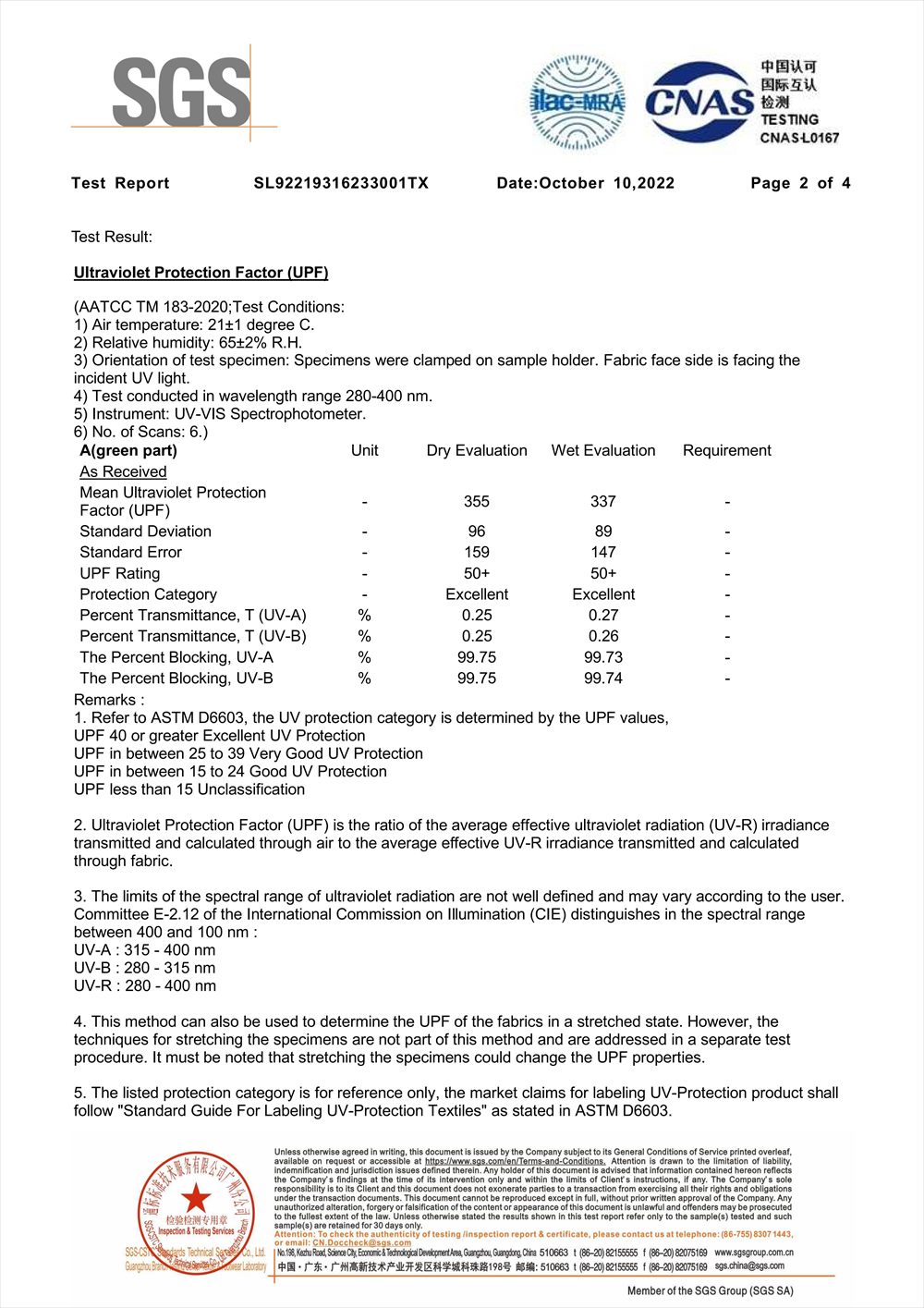
The report shown above records mean UPF values of 355 dry and 337 wet for the tested sample, with a UPF50+ rating in both conditions. Those numbers support the identified sample and test conditions. They do not automatically apply to every future color, print, mesh panel, stretch construction, or fabric substitution.
That limitation is not a technicality. It is the reason a buyer should match the approved bill of materials to the supporting report.
Read the fabric and garment as one system
Fiber content alone does not determine sun protection. Two polyester fabrics can produce different results because the yarn, knit density, color, stretch, surface treatment, and moisture state are different.
The CDC’s clothing guidance notes that tightly woven fabrics generally offer more protection than loosely woven fabrics and that a wet T-shirt provides less protection than a dry one. For product development, that means a light, open knit should not be treated as equivalent to a denser performance knit just because both use the same fiber.
Check these material questions during sampling:
Does the fabric open when stretched? Pull the sample across the chest, elbows, shoulders, and upper back. If the knit becomes visibly more open, ask whether the tested condition reflects the intended fit.
Does moisture change appearance or hand feel? Fishing shirts encounter sweat, spray, rain, and humidity. A wet evaluation can be useful when those conditions matter to the product.
Does the print change the construction? Sublimation usually becomes part of a suitable polyester surface, while other decoration methods add material. Either way, color, ink system, transfer conditions, and artwork coverage should be reviewed on the approved fabric.
Will mesh panels carry the same claim? Vent panels can improve airflow, but a different knit may have different UV transmission. Do not let one main-body report silently stand in for every panel.
Our article on choosing fabrics for custom fishing shirts compares fabric decisions in more detail.
Coverage and fit determine what the shirt protects
A high rating applies only where the tested textile covers the body. The ARPANSA sun-protective clothing guidance also notes that protection may be reduced by wetness, stretch, wear, and chemicals.
For a fishing shirt, review:
- Sleeve length while the arm is fully extended
- Collar or hood coverage around the neck
- Cuff stability during casting and reeling
- Body length when sitting, bending, and wearing a life vest
- Fit across the full size range, not only the medium sample
- Gaps created by zippers, plackets, mesh, or loose face openings
A custom fishing hoodie adds coverage around the head and neck. A button-up fishing shirt may give the buyer more control over collar, vent, and pocket construction. A fishing polo can work for resort or tournament programs that want a cleaner uniform appearance.
There is no single silhouette that wins every use case.
Match the shirt to the fishing program
| Program | Useful priorities | Questions for the sample review |
|---|---|---|
| Offshore or open-water | Long coverage, stable cuffs, tested sun-protection claim, quick moisture handling | Does the shirt stay in position in wind and repeated casting? |
| Kayak or guide use | Seated body coverage, shoulder mobility, hood or collar stability | Does the hem remain covered under a life vest or seat position? |
| Tournament team | Consistent sizing, artwork placement, sponsor visibility, repeatable color | Does decoration align across panels and size grades? |
| Resort or lifestyle retail | Clean fit, collar shape, soft hand, practical sun-protection story | Can the garment move from outdoor use to casual wear? |
| Value-led wholesale | Stable base fabric, controlled color range, clear evidence, repeatable production | Is the same approved material available for reorders? |
The word “best” changes with the program. A lightweight hooded shirt for a kayak guide and a structured polo for resort staff should not be evaluated by the same fit brief.
Questions to send a fishing shirt supplier
Before paying for bulk production, ask for specific answers rather than a general promise of “UV fabric.”
- Which exact fabric and color does the UPF report cover?
- What test method and conditions are listed?
- Was the sample evaluated wet, stretched, washed, or printed?
- Are mesh panels, cuffs, and other secondary materials included?
- Will the bulk order use the same construction and supplier as the tested sample?
- How will substitutions be approved?
- What label and product-page wording does the report support?
- Which measurements control sleeve, cuff, hood, collar, and body coverage?
- What tests or inspections will be repeated if the material changes?
These questions also help separate a real production discussion from a catalog-only sales pitch.
A practical approval sequence
Start with the intended market and use case. Choose the garment format, shortlist fabrics, and review available reports. Then make a sample in the correct size, color, artwork, and panel construction. Check it dry and damp, with the accessories the customer will actually use. Approve the claim only after the material and garment details are stable.
The final decision should combine four things:
- A relevant report for the agreed material
- Coverage that remains useful during movement
- Comfort appropriate to the climate and activity
- Production controls that keep reorders consistent
Is UPF50+ always the best fishing shirt rating?
UPF50+ gives a larger UV-transmission margin than UPF30, but rating alone does not determine fit, coverage, comfort, or production quality. See our UPF30 vs. UPF50+ comparison for the rating difference.
Does dark fabric always provide better sun protection?
Color can influence UV transmission, but it is only one factor. Construction, density, stretch, moisture, and finish also matter. Use the report for the actual material rather than relying on color alone.
Can a mesh fishing shirt be UPF50+?
It may be possible for a particular mesh or garment to achieve a stated rating, but the relevant material must be tested. Do not assume a vent panel shares the main body’s result.
Do anglers still need sunscreen with a UPF shirt?
Protective clothing covers only part of the body. The FDA’s sun-safety advice recommends combining protective clothing with other measures, including sunscreen on exposed skin, shade, hats, and sunglasses.