What the buyer arrived with
The buyer arrived with a defined tournament-shirt program rather than a general request for custom apparel. The order covered 800 long-sleeve fishing shirts in four colorways, with exactly 200 pieces assigned to each color. That equal split made color control and quantity reconciliation central to the project from the start.
The garment also had to work as fishing apparel in strong Australian sun. The agreed specification called for UPF 50+ sun protection, a lightweight feel, useful stretch, and an all-over printed design that could run across the body and sleeves without a heavy surface print. The club needed the four colorways to look related while remaining easy to separate during production and packing.
We used the first two days to turn those requirements into one production brief. During that exchange, the team confirmed the total quantity, the 200-piece allocation for each color, the long-sleeve crew-neck construction, the fabric composition, the target fabric weight, and the artwork route. Fixing those points before sampling reduced the risk of producing a sample that looked right but did not match the order's performance or volume requirements.
The equal color split also affected how the order had to be managed. A shortage in one color could not be hidden inside the overall total, because the club required four complete 200-piece groups. We therefore treated color identification, artwork-file control, and packed-quantity records as part of the product specification rather than leaving them until the end of production.
How we selected the fabric and print route
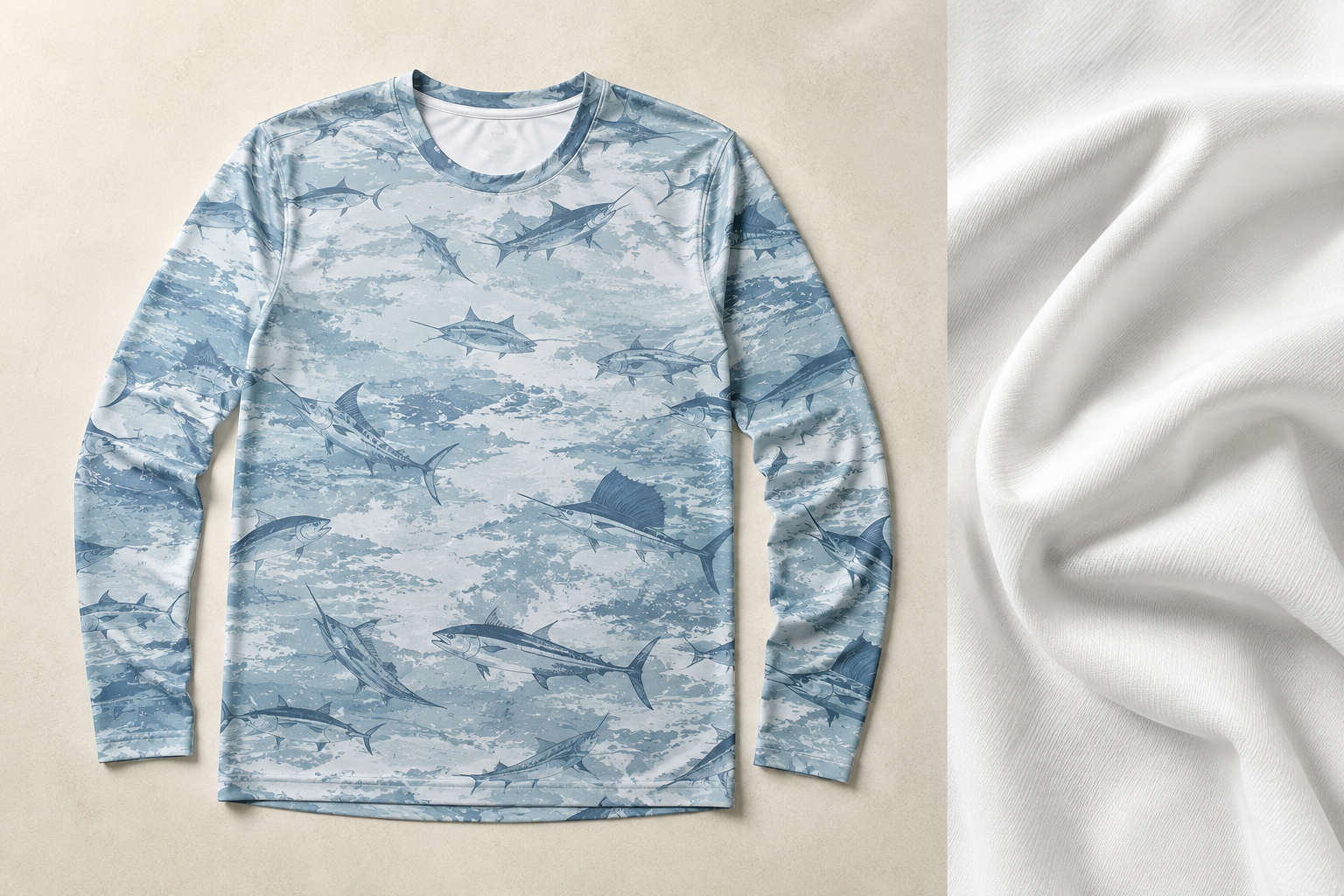
The chosen fabric was a 170 GSM knit made from 92% polyester and 8% spandex. GSM means grams per square metre and describes fabric weight. At 170 GSM, this material gives the shirt enough body to hold its shape and display the artwork cleanly without moving into the heavier feel of a cold-weather jersey.
Polyester formed 92% of the blend because it supports dye-sublimation printing and dries faster than an absorbent natural-fibre base. The 8% spandex content added stretch for casting, reaching, and movement on a boat. This blend also allowed the fabric to recover after movement instead of relying on an oversized cut for comfort. The material specification included UPF 50+ performance for sun protection.
All-over sublimation matched the artwork better than a large screen print or heat-transfer panel. Sublimation moves the color into the polyester fibres, so the fish illustrations and ocean texture can cover the front, back, and sleeves without placing a thick ink layer on top of the shirt. It also made the four-color program practical because the same approved garment pattern could carry four coordinated artwork files.
The spandex content made sample verification especially useful. Sublimation applies heat to transfer the artwork into the polyester fibres, and the finished sample showed how the 170 GSM stretch knit behaved after printing and sewing. The buyer could assess the printed hand feel, fabric recovery, and garment proportions on the actual material instead of approving the project from a flat artwork file alone.
The sample used a long-sleeve crew-neck silhouette with a narrow stretch neckline and clean sleeve-to-body joins. The construction kept the focus on movement and print continuity. Artwork scale was checked across the torso and sleeves so large fish motifs did not collect awkwardly at the neckline, cuff, or side seam. These decisions linked the fabric, garment pattern, and sublimation file before bulk production began.

170 GSM with UPF 50+ sun-protection performance.
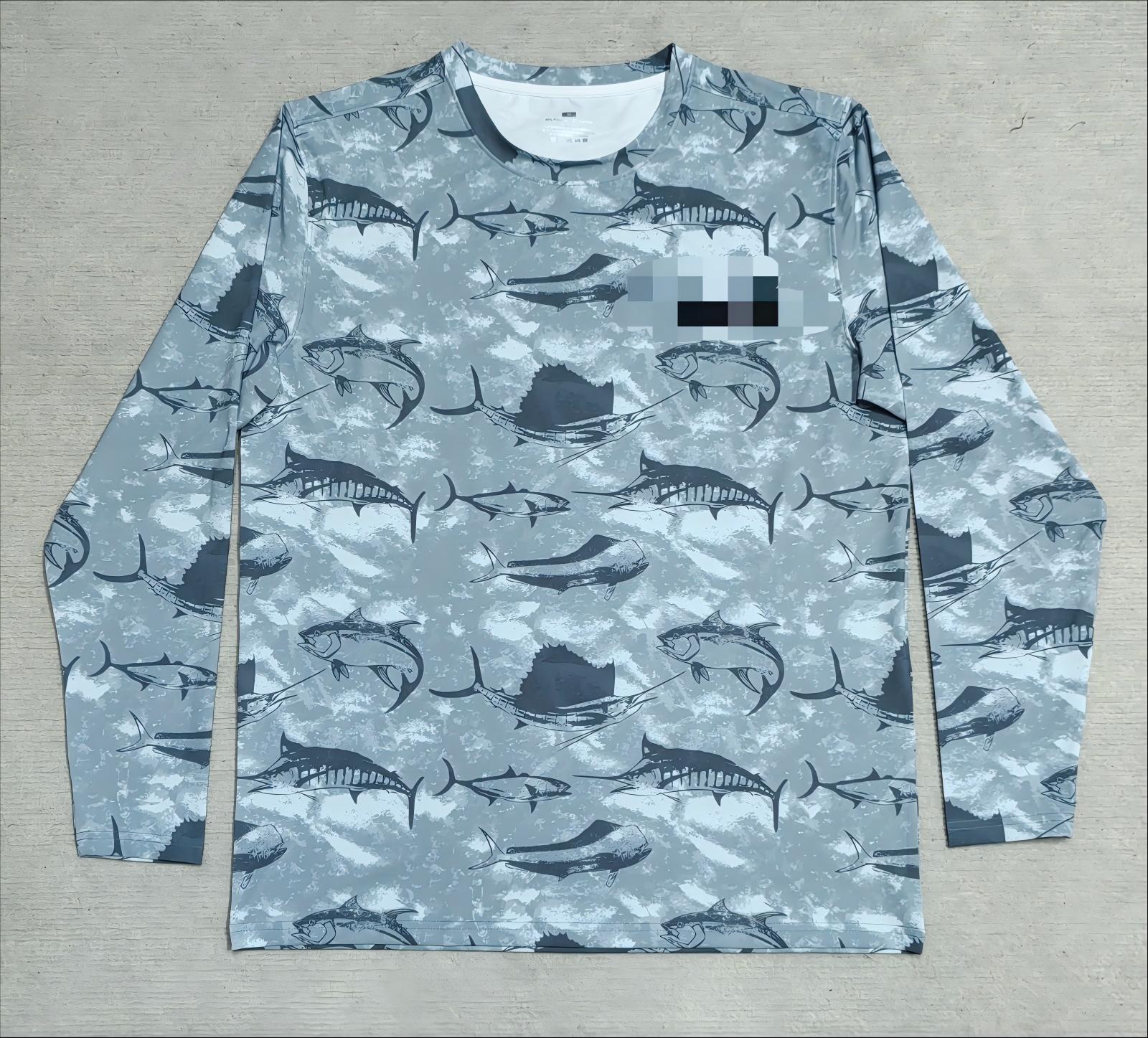
The customer mark is concealed to protect the buyer's identity.
Two days to confirm the brief, then 10 days to make the sample
The sampling schedule began only after the core variables were confirmed. Two days of communication established the quantity breakdown, fabric, UPF requirement, construction, and artwork direction. This gave the sample room a single reference set instead of separate messages with conflicting instructions.
- Days 1–2: specification alignment. We confirmed 800 pieces, four colorways, 200 pieces per color, 170 GSM fabric, 92% polyester and 8% spandex composition, UPF 50+ performance, and all-over sublimation.
- 10-day sample development. The team prepared the artwork for the garment panels, printed the sublimated fabric, cut the approved pattern, assembled the shirt, and finished the physical development sample.
- Bulk-production checkpoint. The completed sample provided a physical reference for print scale, hand feel, stretch, neckline finish, sleeve proportion, overall length, and the relationship between the fish motifs and panel seams.
The recorded sample stage took 10 days. We have not added extra revision rounds to the case because the confirmed timeline only supports that development period. The important control point was the finished sample itself: it connected the digital artwork and written fabric specification to a garment the buyer could assess before the 800-piece order moved forward.
Production checks specific to this order
This production run required two controls beyond ordinary garment inspection: four colorways had to stay visually coordinated, and each color had to finish at 200 pieces. Before panel production, the team checked the fabric and artwork against the sample specification: 170 GSM, 92% polyester, 8% spandex, UPF 50+ performance, and the approved all-over fish pattern.
Print preparation was controlled by colorway rather than treating all 800 pieces as one undivided run. Each artwork file needed the same motif scale and panel positioning while carrying its own color values. During sewing, the checks focused on neckline shape, sleeve and side seams, print alignment at panel joins, overall measurements, and the clean handling of the stretch fabric.
The final packing count was reconciled by colorway so the four 200-piece groups added back to the 800-piece order total. Keeping that commercial split visible throughout production reduced the chance of finishing the correct overall quantity with an incorrect balance between colors. The bulk manufacturing stage was completed in three weeks.
Delivery and result
After the three-week production stage, transport to Australia took two weeks. The combined bulk-production and transport period was therefore about five weeks, following the earlier two-day specification discussion and 10-day sample-development stage.
The documented outcome was an 800-piece long-sleeve tournament-shirt program delivered as four coordinated colorways of 200 pieces each. Every color used the same 170 GSM polyester-spandex base, UPF 50+ performance specification, and all-over sublimation route. This gives future club and tournament buyers a concrete reference for the quantity, material, sampling time, production time, and transport time involved in a multi-color custom fishing-shirt order.