A custom button-up fishing shirt is not the same product as a sublimated fishing jersey. It normally uses a woven shell, a structured collar and placket, separate pocket components, and more trim decisions. If the shirt also needs a cape back, underarm mesh, roll-up sleeves, corrosion-resistant snaps, women’s grading, and a private-label package, the supplier must coordinate several operations that a basic print shop never touches.
The five companies below offer different routes for a US brand. Some publish direct evidence of woven fishing-shirt production. One offers domestic US development and cut-and-sew work without claiming to be a fishing specialist. The list is ordered by fit for specific buying situations, not by a claim that one factory has universally better quality.
The Shortlist at a Glance
| Company | Published production base | Best fit | Public MOQ signal | Main point to verify |
|---|---|---|---|---|
| EZ Fishing Wear | Dongguan, China | Low-MOQ, fishing-specific OEM and private label | From 100 pcs for button-up programs | MOQ by fabric, color, closure, and branding package |
| ARGYLE Haus | Los Angeles, USA | Domestic pattern, sample, and Made in USA production route | No MOQ for development; production guidance is generally around 500 pcs per style or more | Fishing-specific fabric, vent, trim, and UPF experience |
| Precision Graphics | Tempe, Arizona, USA | Low-volume stock button-front shirts with US decoration | Low minimums published for embroidery; quote required by garment | Blank brand and availability, plus the limit of stock-garment customization |
| Qiandao Apparel | Dongguan, China | Feature-heavy stretch button-ups and material choice | Not stated on the reviewed product page | MOQ, test report match, and bulk price behind displayed sample pricing |
| On The Island Apparel | Huntington, New York, USA | Samples and small logo-decorated stock button-up orders | One-piece minimum for in-house decoration | Blank sourcing, size and color stock, and lack of original OEM development |
How We Selected These Companies
We looked for evidence tied to the actual product, not the phrase “custom fishing apparel.” A company received more weight when its own site showed or described a woven button-up, named relevant construction such as a vented yoke or chest pockets, and explained pattern, sampling, labeling, or private-label work.
We also separated three business models:
- a direct OEM factory developing the garment under the buyer’s label;
- a domestic development and production house building a pattern from the ground up;
- a supplier working from existing fishing-shirt blocks and decorating or modifying them.
All three can be valid. They do not create the same cost structure, intellectual-property position, MOQ, or control over repeat orders. Public website claims are only a screening layer. A fit sample, company verification, fabric report, written specification, and pre-shipment inspection still decide whether a supplier belongs on your purchase order.
1. EZ Fishing Wear — Best for Low-MOQ Fishing-Specific OEM
Why it is on the list: EZ Fishing Wear has a dedicated custom button-up fishing shirt program rather than treating the style as a variation of a printed jersey. The published development scope includes woven fabric selection, custom pockets and vents, button or snap choices, embroidery or heat-transfer branding, labels, size work, packaging, and export coordination.
For a US startup, the main advantage is the starting scale. Custom button-up programs can begin from 100 pieces, with sizes mixed inside one approved style. That makes a first commercial test more realistic than a factory built around 500-piece color minimums. The exact minimum can rise when the buyer requests a custom-dyed fabric, unique hardware, several colorways, or special packaging.
EZ Fishing Wear is most useful when the buyer has a reference shirt or product idea but still needs help converting it into a production file. We can compare stock stretch wovens and ripstops, develop a men’s or women’s block, make a physical sample, and lock pocket dimensions, vent construction, logo method, labels, and packing before bulk cutting.
What to verify in the quote: Ask for the fabric composition and finished GSM, stock-color status, MOQ per color, testing available for the selected fabric, sample revision terms, and FOB versus delivered pricing. A “100-piece MOQ” should never be read as permission to divide 100 pieces across any number of fabrics and colors.
Possible drawback: Production is in China. US brands must allow for courier time during development, international freight, duties, and time-zone differences. Our US program page explains the planning points that should be settled before sampling.
2. ARGYLE Haus — Best for US-Based Development and Production
Why it is on the list: ARGYLE Haus of Apparel states that it owns a production facility in San Fernando, California, and performs design, patternmaking, sample sewing, fit testing, and manufacturing in its Los Angeles operation. Its startup package includes a pattern, sample, revisions, grading, a small pilot run, and a production tech pack.
That structure suits a brand that wants to attend fittings, keep development close, or build a defensible Made in USA position. It may also suit a founder whose idea is not yet ready for an overseas factory quote. A technical button-up has many pattern relationships—collar stand, placket, shoulder reach, cape depth, pocket placement, sleeve roll tab—that benefit from hands-on development.
What to verify in the quote: ARGYLE presents itself as a full-service apparel manufacturer, not a fishing-shirt specialist. Ask whether it has handled lightweight UPF wovens, mesh-lined vents, corrosion-resistant snaps, and fishing-specific movement tests. Confirm whether fabric, labels, trims, or any processes come from outside the United States and what origin claim the final garment can lawfully use.
Possible drawback: The company says development has no MOQ, while production for growing e-commerce brands is generally around 500 pieces per style or more. Development accessibility does not mean a very small bulk order will have the same economics as an overseas stock-fabric program.
3. Precision Graphics — Best for US-Decorated Stock Button-Front Shirts
Why it is on the list: Precision Graphics is a Tempe, Arizona, decoration company founded in 1981. Its fishing-shirt page lists button-front models from Columbia, Eddie Bauer, Paragon, Port Authority, and other established blank-apparel brands. The company says embroidery, digitizing, proofing, and order production are handled in its Tempe shop, with a normal target of 7–10 business days after proof approval.
This route suits a charter, guide service, sales crew, corporate event, or small team that wants a known button-up style with a chest or back-yoke logo. It avoids custom fabric and cut-and-sew minimums because the supplier buys finished blanks and decorates them in the United States. Precision Graphics publishes low minimums for embroidery and provides a digital proof before production.
What to verify in the quote: Confirm the exact blank brand and style, current color and size inventory, UPF rating supplied by that garment brand, logo dimensions, stitch count, placement around the pocket or vent, and replacement terms. If you need several reorders, ask whether the same blank and color can be reserved.
Possible drawback: Precision Graphics is a US decorator, not the cut-and-sew manufacturer of the shirts it sells. This route does not give a brand an original fabric, fit, pattern, private neck label, or exclusive garment. It should be compared as a fast domestic uniform option, not as full private-label OEM production.
4. Qiandao Apparel — Best for Feature-Heavy Stretch Wovens
Why it is on the list: Qiandao Apparel’s button-down product page names a polyester/spandex stretch woven, underarm ventilation, a mesh-lined back vent, two chest pockets, flexible logo and label positions, and an optional lens-cleaning panel. A second published style uses a 140 GSM nylon/spandex woven. These are relevant starting points for a premium guide shirt or coastal retail product.
The supplier publishes a Dongguan, Guangdong address and describes OEM support for custom fit, plus-size grading, private labels, and feature changes. That level of product detail makes the first technical conversation easier than approaching a general sportswear vendor with no woven-shirt evidence.
What to verify in the quote: Ask for fabric swatches with traceable codes, the UPF report for the selected code and color, dimensional-stability results, and evidence for any quick-dry or water-repellent claim. The dollar figures displayed on product pages should not be treated as a finished bulk quote; packaging, development, test work, logos, freight, and order structure can change the landed cost.
Possible drawback: The reviewed product page does not publish a clear MOQ for the style. Get written minimums per fit, fabric, color, and decoration before investing in a sample.
5. On The Island Apparel — Best for Samples and Very Small Decorated Orders
Why it is on the list: On The Island Apparel is a Huntington, New York, custom-apparel shop that lists the Port Authority W960 long-sleeve UV Daybreak shirt. The woven stock garment uses lightweight polyester poplin, two covered chest pockets, a mesh-vented back, adjustable cuffs, and roll-up sleeve tabs. The company decorates apparel in-house with embroidery or DTF and ships nationwide.
The supplier publishes a one-piece minimum for its in-house apparel decoration. That makes it practical for a logo sample, a founder’s wear test, or a small crew order before committing to a custom OEM product. Its Huntington address, contact details, and decoration process are clearly stated, and buyers can arrange a shop visit.
What to verify in the quote: Confirm stock by size and color, the blank manufacturer’s current specification, logo method, proof and sample timing, and whether the supplier can keep the same style available for repeat orders. Ask which garment warranty applies after decoration, since decorated products are normally restricted from return.
Possible drawback: The shop sources finished blank garments; it does not claim to create a new fishing-shirt pattern or custom fabric. A one-piece minimum applies to decoration, not to original private-label manufacturing. Buyers needing custom measurements, proprietary labels, exclusive trims, or owned patterns should use an OEM route.
What a US Brand Should Put in the RFQ
Send all five suppliers the same request for quotation. At minimum, include:
- Men’s, women’s, or unisex fit, plus the intended US customer and size range.
- Long or short sleeves, collar shape, front closure, pocket count, vent type, and roll-tab requirement.
- Target fabric composition, GSM range, stretch, hand feel, color route, and required performance claims.
- Finished-garment measurements or a reference sample, with ownership requirements for new patterns and grading.
- Logo methods, private neck label, care/content label, hangtag, barcode, polybag, and carton marking.
- Quantities by style, fit, color, and size—not one total number.
- Sample types, included revisions, bulk lead time, inspection method, Incoterm, and US delivery ZIP code.
For US retail, labeling cannot be left until packing. The Federal Trade Commission’s textile guidance says most covered textile products need fiber content, country of origin, and the identity of the manufacturer or responsible marketer. The FTC also maintains a separate Care Labeling Rule. Your factory should prepare correct physical labels, but the US importer or brand should approve the final wording.
If you plan to claim UPF performance, define the test and claim before bulk. A report must match the proposed fabric closely enough to support the marketed product. Mesh panels, pale colors, stretch, wet use, and material substitutions all deserve attention. Keep the approved report, fabric code, color list, and production specification in the same product file.
Questions to Ask Before You Choose
Is the supplier a manufacturer or a decorator?
Ask who makes the pattern, cuts the shell, sews the garment, installs snaps, decorates it, performs inspection, and packs it. A local sales office or printer can still be a good supplier, but you should know which company controls the repeatable product.
Should a new brand choose stock fabric?
Usually, yes. A proven stock fabric can lower the opening quantity, shorten development, and make replacement yardage easier. A custom color or custom weave becomes more sensible after sales volume can support the material minimum.
Is the cheapest sample the best first test?
No. Request a comparison sample that uses the proposed fabric and main construction. A cheap blank with a logo does not test the cape vent, shoulder reach, pocket bulk, snap reinforcement, or finished label package you intend to sell.
Can one UPF report cover every color?
Do not assume it can. Ask the laboratory or qualified compliance adviser whether the report scope covers the colors, fabric treatment, and garment claim you plan to use. Test the weakest likely configuration when practical.
Who should own the pattern and artwork?
Put ownership and permitted use in writing before development begins. If the supplier uses a proprietary stock block, clarify which adjusted files can be released. If you fund an original pattern and grading, state the files and rights you expect after payment.
Our Recommendation
For a 100–250 piece fishing-brand launch, begin with a fishing-specific factory that can quote a stock woven, a physical fit sample, and complete private-label finishing. For a domestic premium line, compare that landed proposal with a Los Angeles development route. For a logo sample or small crew order, a US decorator can be faster because it works from finished blank inventory. For 500 pieces or more, ask OEM and domestic development options to quote the same specification so the comparison includes development fees, material minimums, inspection, duty, and freight—not just sewing price.
Use this shortlist to decide who deserves an RFQ, not who deserves a deposit. Then score the replies for specificity. A supplier that identifies open questions, proposes a testable fabric, and separates confirmed facts from assumptions is already giving you evidence about how it will handle production.
Review our fishing apparel tech pack checklist, manufacturer evaluation process, and MOQ and sampling breakdown before requesting samples. When your brief is ready, send it to EZ Fishing Wear for a button-up development proposal.
Last updated: September 14, 2026 | Victor, Founder of EZ Fishing Wear | Dongguan, China
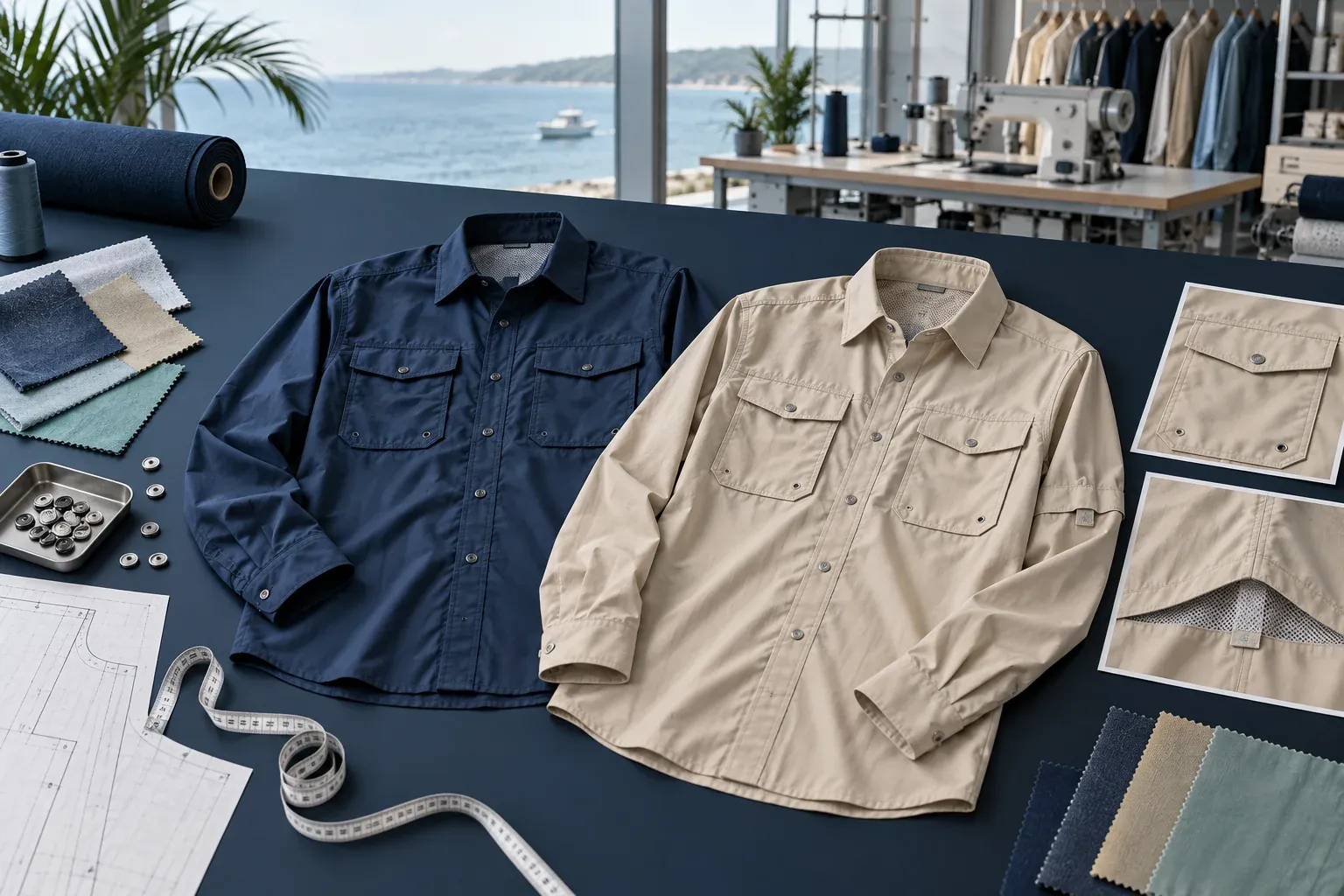
The hero image is an original editorial visualization created for this article. It does not depict any listed supplier’s factory or product.