A first order that had to establish the brand
The buyer was building a U.S. hunting brand and starting with a controlled 100-piece order. That quantity was large enough to launch a real product, but small enough that every construction choice affected the value of the first collection. The shirt needed to present a clear brand identity while still giving hunters practical reasons to choose it over an ordinary short-sleeve button-up.
The challenge was not simply adding more features. A hunting shirt can quickly become visually busy if embroidery, printed artwork, pockets, tabs, buttons, and ventilation all compete for attention. The buyer wanted a restrained khaki exterior that could move between the field and everyday wear, with the more distinctive brand artwork revealed through selected details rather than printed across the entire body.
We therefore treated the project as one connected product system. The 150 GSM polyester base, short-sleeve shape, button-down collar, dual chest pockets, embroidery placements, hidden collar print, cleaning cloth, and rear vent all had to work together. Confirming those relationships before the sample prevented one feature from blocking another during sewing or changing how the finished shirt sat on the body.
Why 150 GSM polyester suited the shirt
We selected a 100% polyester fabric at 150 grams per square metre, commonly written as 150 GSM. This weight gave the woven-style shirt enough body for a clean collar, button placket, and structured pocket flaps while remaining suitable for a lightweight short-sleeve garment. The fabric also supported the smooth, uniform khaki surface the buyer wanted for a versatile hunting and outdoor look.
Polyester was useful because the project combined solid-color garment panels with heat-sublimated artwork. Sublimation bonds the design into polyester fibres through heat rather than leaving a thick print layer on the surface. Instead of covering the shirt with graphics, we kept the main body understated and placed the printed hunting artwork inside the collar. The detail becomes visible when the collar opens without overpowering the exterior.
The fabric also provided a stable base for embroidery. Stitch density and backing had to be controlled so the chest and upper-back marks stayed crisp without pulling or puckering the lightweight material. The two placements served different purposes: the smaller chest embroidery gave the front a retail-ready identity, while the larger upper-back mark remained visible above the ventilation yoke.
Field details built into a clean button-up
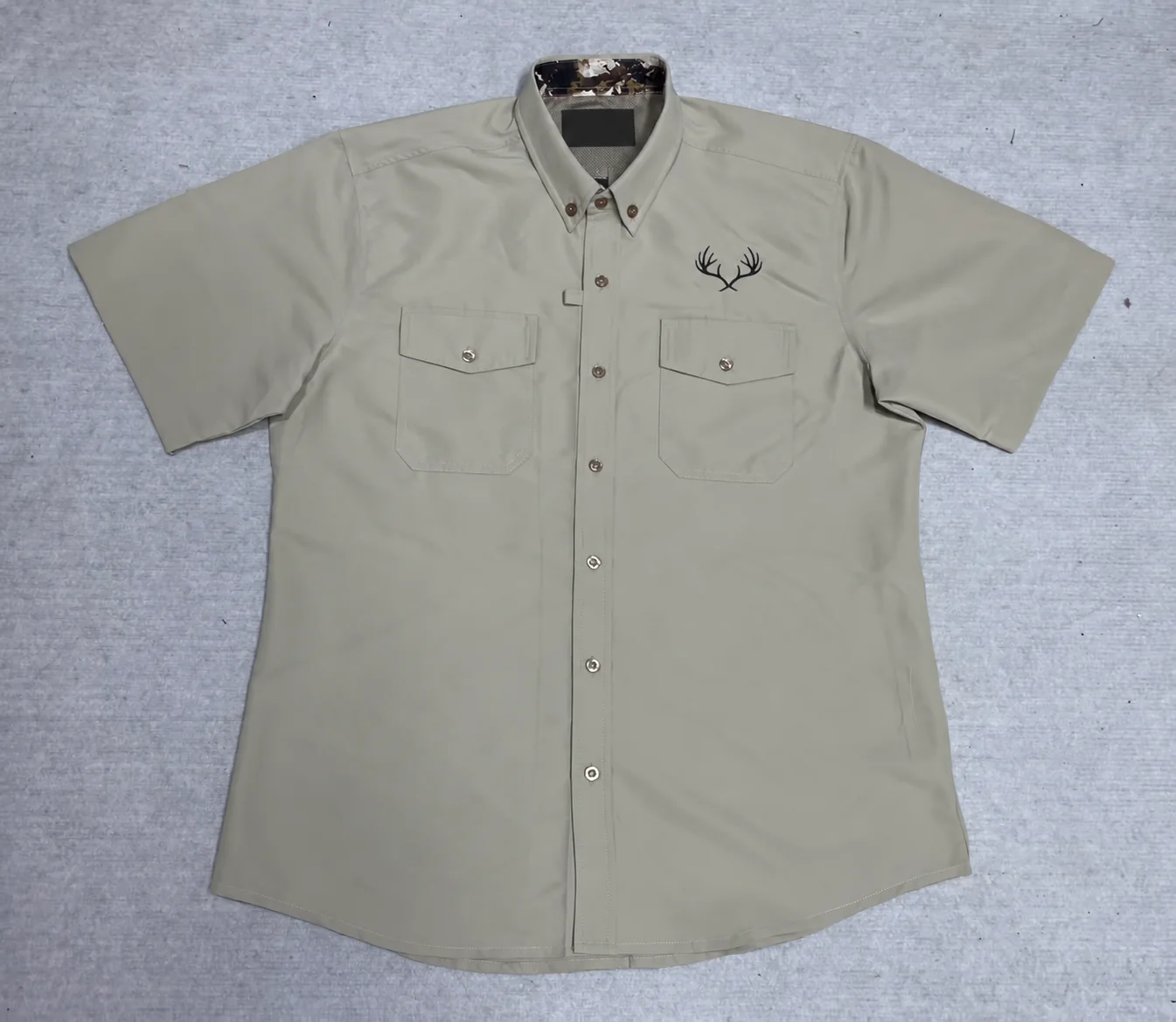
The front construction combined a button-down collar with two flap chest pockets. The collar points are secured so they stay controlled during movement and wind, while the two pockets give the wearer separate storage zones for small field items. Angled lower corners on the pocket flaps keep the shape purposeful and prevent the front from looking like a generic work uniform.
We added a small attachment loop beside the placket for an easy-access item such as eyewear, then included a soft eyeglass-cleaning cloth as a dedicated functional detail. Hunters frequently move between dust, humidity, fingerprints, and changing light, so a cleaning surface inside the garment is more useful than a decorative feature that adds bulk. Its position was chosen to remain discreet when not in use.
Ventilation was handled through the back rather than exposed mesh on the main body. A horizontal yoke covers the mesh panel, allowing warm air to escape while shielding the opening and keeping the exterior clean. The back embroidery sits above this vent so the stitching does not close the airflow area or interfere with the mesh. Small retention points along the flap help the layer hold its shape without sealing the opening.
Private-label execution completed the product. The interior neck label, custom collar artwork, embroidery, pocket construction, buttons, and curved hem were evaluated as one presentation rather than separate add-ons. This matters for a startup because buyers see the whole garment at once. Consistent scale, color, and placement make a first product feel deliberate even when the opening production run is only 100 pieces.
Chest embroidery, dual flap pockets, button-down collar, attachment loop, and a concealed eyeglass cloth.
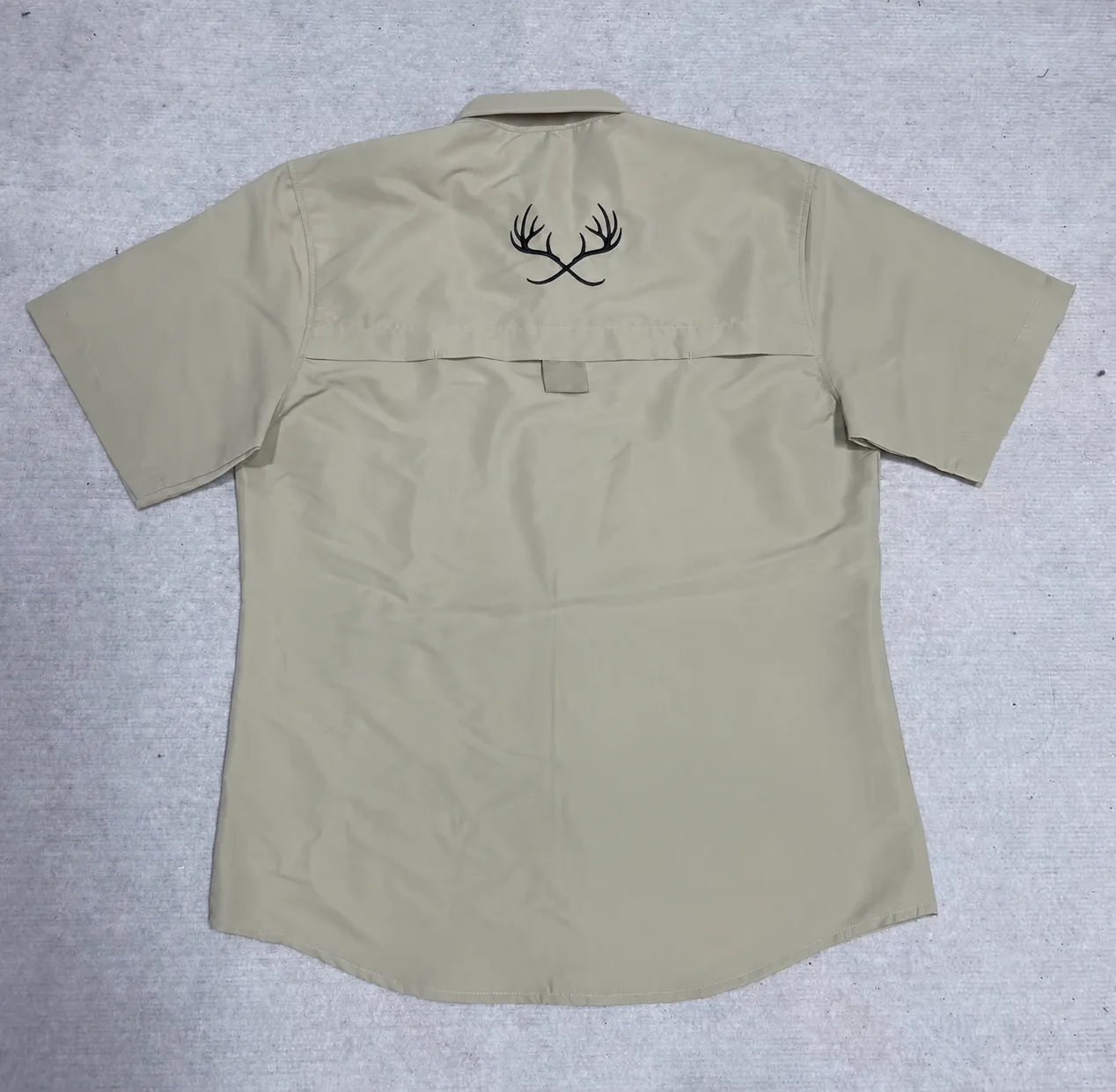
The embroidery stays above the vent so the mark remains visible without restricting airflow.
Two-week sampling focused on feature relationships
The custom sample was completed in two weeks. This stage converted the approved feature list into one physical shirt and gave the buyer a clear reference for the 100-piece run. The review covered overall fit, collar shape, pocket symmetry, placket alignment, embroidery scale, inner-collar artwork placement, vent opening, and the accessibility of the eyeglass cloth.
Several checks depended on seeing the assembled garment. The upper-back embroidery needed enough distance from the yoke seam to avoid crowding the vent. The heat-sublimated collar print had to sit inside the collar cleanly without showing as an unintended strip when the shirt was buttoned. On the front, the chest mark, two pocket flaps, and attachment loop needed visual balance across the placket.
The sample also became the control garment for production. Rather than relying on separate artwork files and written notes, sewing, embroidery, print placement, and finishing teams could check their work against the same physical reference. That was especially important for a feature-rich first order where a small placement shift could change both appearance and function.
Three-week bulk production and the launch result
Bulk production for the 100 shirts was completed in three weeks after sample approval. Checks for this run focused on the details that defined the product: consistent khaki color, stable 150 GSM fabric, matching pocket height, secure buttons, clean embroidery edges, accurate collar-print placement, open mesh vents, and accessible cleaning cloths. The final quantity was reconciled against the approved size breakdown before packing.
The buyer reported being very satisfied with the finished shirts and told us that sales performed well after launch. We present that as the customer's feedback, not as an invented sell-through percentage or a claim about revenue. The result that can be verified from this project is a completed 100-piece first run with the private-label and field features shown in the product photographs.
For another startup, the useful lesson is that a small opening order does not need to look generic. A restrained base garment can carry strong product identity when embroidery, hidden print, storage, cleaning, and ventilation are planned together. That gives the brand a product it can test in the market while preserving a clear specification for future production.