
If you are comparing quotes for custom fishing shirts in Australia, the cheapest unit price is rarely the cheapest finished order.
A local supplier may quote a higher price but include easier communication, local delivery, and a smaller commitment. A direct factory may offer a lower garment cost and much more control over fabric, fit, and artwork, but the buyer has to account for sampling, freight, import charges, and production management.
The useful comparison is not local price versus factory price. It is total landed cost versus the amount of product control you need.
Local supplier or direct factory: the short answer
For a small one-off event where speed matters more than custom development, a local supplier is often the practical choice. For a fishing brand, tournament series, wholesaler, or repeat uniform program, direct factory production usually becomes more competitive once the order is large enough to spread development and freight costs across the run.
The break-even point is different for every project. Fabric, printing method, number of designs, size range, packaging, and delivery location all move it.
| Cost area | Local supplier | Direct factory |
|---|---|---|
| Garment unit price | Usually higher | Usually lower at production volume |
| MOQ | Often lower for stock garments | Commonly 50-100 pieces per style or design |
| Fabric choice | Limited to available blanks | Fabric weight, stretch, UPF direction, color, and finish can be developed |
| Artwork | Usually decoration on a stock garment | Panel-based sublimation, custom trims, labels, and all-over artwork are possible |
| Sampling | Simple if using an existing blank | Prototype and pre-production approval are important |
| Freight and import | Often included in the quote | Must be included in landed-cost calculations |
| Lead time | Faster for stock-based orders | Longer upfront, but repeat orders can be planned efficiently |
| Quality control | Managed locally | Must be specified and documented before shipment |
What a direct-factory quote actually covers
Factory quotes can look deceptively simple. A price such as AUD 18 or AUD 24 per shirt does not tell you whether it includes custom fabric, individual packaging, size labels, inspection, freight, or duties.
Before comparing it with a local quote, confirm the following:
- Is the price based on one design or several designs?
- Does the MOQ apply per style, per color, or per artwork?
- Are custom neck labels, care labels, hangtags, and polybags included?
- Is sampling charged separately, and is the sample fee refundable?
- Does the price include an approved performance fabric or only a standard polyester option?
- Is freight quoted to an Australian port, airport, warehouse, or business address?
- Who pays import duty, GST, customs clearance, and destination charges?
The Australian Border Force explains the basic responsibilities that apply when goods are imported into Australia. Buyers should check the current requirements on the Australian Border Force importing goods page rather than assuming a factory’s freight quote includes every local charge.
Where direct manufacturing usually saves money
The strongest savings do not always come from sewing. They often come from removing markups and building the shirt correctly from the beginning.
The fabric is selected for the actual use
A stock shirt may be close to what you need, but it can still be too heavy for Queensland humidity, too warm for tournament crews, or too unstable for an all-over print. Direct development lets the buyer compare fabric weight, stretch, moisture management, hand feel, and the intended UPF claim before production.
That matters when the shirt is part of a retail collection rather than a promotional giveaway. Our article on choosing fishing-shirt fabric for Australian conditions explains why fiber content alone is not enough to approve a performance fabric.
The artwork is built into the garment
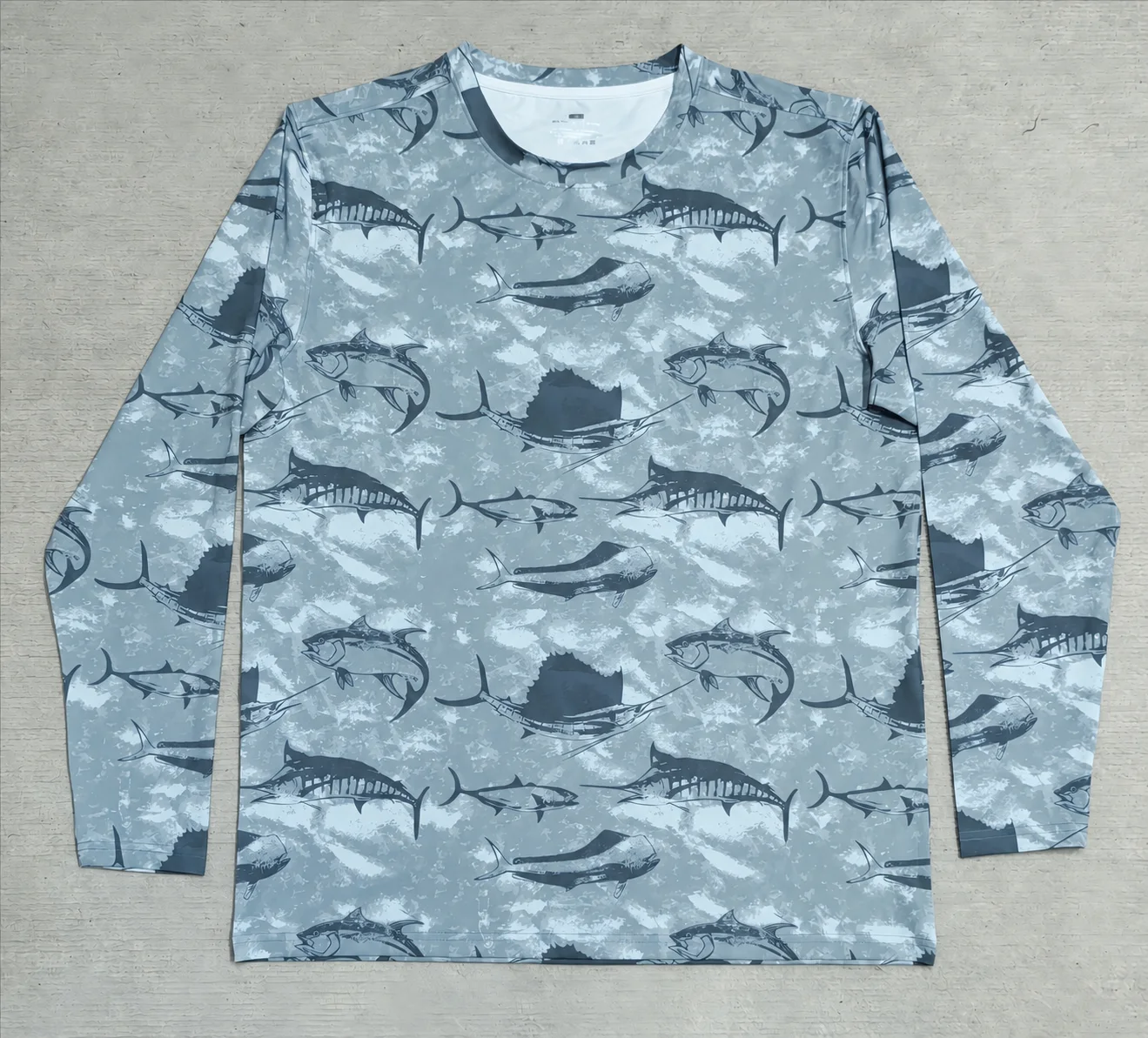
For sublimated fishing shirts, artwork is printed before the panels are cut and sewn. Sponsor logos, fish graphics, sleeve marks, and color blocks can run across the whole garment without adding a thick surface layer.
This is different from buying a finished blank and adding a chest print locally. It also means panel alignment, seam placement, color approval, and print scale need to be checked during sampling.
Repeat orders become easier
Once the fit, pattern, artwork, trims, and packaging are approved, a repeat order does not start from zero. A well-managed factory keeps the technical references needed to reproduce the style. That can reduce development time and prevent small inconsistencies between seasons.
This is where direct manufacturing tends to make the most sense for Australian fishing brands and distributors: not for one cheap shipment, but for a product line that will be reordered.
Where a local supplier can still be the better decision
Direct factory production is not automatically the right answer.
A local supplier can be more economical when you need 15 shirts next week, want a simple logo on a stock garment, or do not yet know whether the product will sell. Local stock also reduces the risk of holding too much inventory while a new team, club, or retail idea is being tested.
It is also easier to replace a few missing sizes locally. With a custom production run, adding five extra shirts after completion can be disproportionately expensive because printing, cutting, and sewing must be set up again.
Use a local supplier when convenience and low commitment are the priority. Move to a direct factory when product differentiation, repeatability, or margin becomes more important.
The costs buyers most often miss
Samples and revisions
A prototype is not just a miniature production order. It is where the factory checks pattern measurements, collar shape, hood fit, print placement, stitching, and trims. If artwork or specifications keep changing, additional samples add time and courier cost.
Send a clear brief before sampling. Include the target customer, product use, reference photos, expected fabric feel, size range, artwork files, branding positions, packaging requirements, and target delivery date.
Air freight used to rescue a late order
Sea freight may look economical during quotation, but a delayed approval can force part or all of the order onto air freight. The freight difference can erase the unit-price saving.
The safest approach is to work backward from the in-hands date and include time for sample approval, bulk material, printing, cutting, sewing, inspection, export handling, transit, and customs clearance.
Too many low-volume designs
One hundred shirts across one design is not the same production job as one hundred shirts split across ten designs. Every artwork may require a separate print file, color check, panel setup, size breakdown, and packing control.
If the budget is tight, start with fewer core designs and use size depth where demand is strongest.
Claims that are not supported by the approved fabric
Do not treat “sun shirt,” “SPF shirt,” and “UPF 50+ shirt” as interchangeable marketing language. UPF is the clothing-related rating, and a market-facing claim should be supported by relevant testing of the approved material. Our comparison of UPF 30 and UPF 50+ fishing shirts covers the practical distinction.
Cancer Council Australia also recommends checking the UPF rating and using garments that cover more skin. Its overview of sun-protective clothing is a useful consumer-facing reference.
A practical way to compare two quotes
Build one landed-cost sheet and make both suppliers answer the same specification.
Use this formula before comparing the per-shirt result:
Landed cost per saleable shirt = (bulk garments + samples + trims and packaging + inspection + international freight and insurance + duty, GST and clearance + Australian delivery + defect allowance) / saleable units received
GST should not be applied only to the factory invoice in a rough calculation. The Australian Border Force GST guidance states that GST on a taxable importation is 10% of the taxable value, which includes the customs value, applicable duty, and international transport and insurance. Duty rates, concessions, exchange rates, and import arrangements can change, so confirm the current treatment for the actual shipment rather than copying a percentage from an old costing sheet.
Start with these lines:
- Garment and decoration cost
- Sample and courier cost
- Labels, hangtags, and packaging
- Inspection or quality-control cost
- Export freight and insurance
- Import duty, GST, clearance, and destination charges
- Local delivery to your warehouse
- Allowance for defects, replacements, and late changes
Then add the commercial value that a spreadsheet cannot fully show: exclusive artwork, custom fit, fabric control, consistent repeat orders, and the ability to build a recognizable product rather than resell a common blank.
Common questions from Australian buyers
What is a realistic MOQ for custom fishing shirts?
It depends on the construction and supplier. Australian decorators working with stock garments may accept very small runs, while a cut-and-sew factory commonly starts around 50 to 100 pieces for one base style. Ask whether the minimum applies per style, artwork, color, or fabric because splitting one order across many designs can change the workable quantity.
Is a direct factory always cheaper than an Australian supplier?
No. Local supply can cost less for a small urgent order because it avoids overseas sampling, international freight, customs clearance, and production setup. Direct factory sourcing becomes more attractive when the buyer needs a custom garment, has enough volume to spread fixed costs, or plans repeat orders.
How should I compare lead times?
Compare the date the approved shirts arrive at your warehouse, not the number of sewing days. A factory timeline must include artwork preparation, prototype approval, bulk material, printing, cutting, sewing, inspection, export handling, transit, clearance, and local delivery.
Can the factory guarantee a UPF 50+ claim?
A supplier can recommend a tested fabric, but the approved material and claim still need suitable evidence. Confirm the exact test report, fabric reference, color, test method, and any limitations involving stretch, wetness, wear, or garment coverage before placing the claim on a label or product page.
What we need before quoting an Australian project
You do not need a finished tech pack to start, but you do need a clear direction. Send us:
- Product type: T-shirt, sun hoodie, polo, button-up shirt, or mixed range
- Estimated quantity by style and artwork
- Target fabric weight or a reference garment
- Required performance features such as stretch, quick-dry construction, or a tested UPF claim
- Size range and target fit
- Logo and artwork files
- Packaging requirements
- Delivery city and required arrival date
For a first collection, you can review our custom fishing shirts and custom fishing hoodies before preparing the brief. If the project is ready for costing, send the specifications for review. We can separate sample, production, and shipping costs so the comparison is based on the real delivered order rather than an attractive headline unit price.