Australian buyers use “custom fishing shirt” for several different products: a fully sublimated team jersey, a stock button-up with an embroidered logo, an Australian-made performance top, or a factory-developed private-label woven shirt. Those products can all work on the water, but they do not give a brand the same control over fabric, fit, pattern ownership, labels, minimums, or repeat production.
This comparison focuses on suppliers that publish evidence relevant to button-up fishing shirts or offer a production route worth checking. It includes local Australian options and overseas factories serving Australian buyers. The list is ordered by the project each supplier appears best suited to, not by an untestable claim that one makes the “highest quality” shirt.
The Shortlist at a Glance
| Company | Published production or business base | Best fit | Public MOQ signal | Main point to verify |
|---|---|---|---|---|
| EZ Fishing Wear | Dongguan, China | Low-MOQ private-label woven development for Australian brands | From 100 pcs per style and colourway | MOQ by fabric/color and report scope for the intended UPF claim |
| Switchbait | Australian-owned; production location not clear on reviewed page | Low-volume stock-style button-ups with local account support | 10 on product page; 25 in a linked catalogue | Current MOQ, manufacturing location, private-label options, and correct standard version |
| Bigfish Gear | Darwin, Australia, plus an offshore range | Australian-made custom performance shirts | Not published on reviewed page | Woven button-up capability, material choice, MOQ, and private-label terms |
| SRL Sports | Australian company; production location not clear on reviewed page | Sublimated club, tournament, and event button-ups | 10 pcs on product page | Whether the quoted button-up is woven, private-label rights, and exact lead time |
| Qiandao Apparel | Dongguan, China | Higher-spec stretch-woven features from a factory-direct source | Not stated on reviewed product page | MOQ, legal/factory verification, report match, and delivered cost |
How We Compared the Suppliers
We looked for public evidence of a real button-up construction: woven fabric, front placket, chest pockets, roll-up sleeves, vented back, or named closure options. We then considered fit development, private labels, production location, order minimum, and whether the supplier’s published UPF language could be traced to an Australian standard.
The method exposes an important gap in the market. Several Australian businesses are strong at low-volume custom teamwear, but their sites focus on full sublimation and do not always state whether the garment is woven, where it is sewn, or whether another brand can remove the supplier’s labels. Overseas OEM factories publish more customization but require stronger due diligence and longer freight planning.
Neither route is automatically better. A 20-shirt charter order and a 500-piece retail launch should not use the same shortlist.
1. EZ Fishing Wear — Best for Low-MOQ Private-Label Development
Why it is on the list: EZ Fishing Wear offers custom button-up fishing shirts with woven fabric sourcing, pattern and measurement work, back and underarm ventilation, custom pockets, button or snap closures, embroidery or heat-transfer branding, private labels, and retail packaging. The Australian program starts from 100 pieces per style and colourway and includes planning around care labels, UPF evidence, freight, and Australian delivery.
This route suits a fishing brand, tackle retailer, or distributor that wants its own product rather than a decorated team shirt. A buyer can start from a reference garment or an existing block, compare stock ripstop and stretch-woven options, then approve a physical sample before bulk. Men’s, women’s, youth, and unisex size work can be discussed, with sizes mixed inside one approved style.
What to verify in the quote: Confirm the minimum per fabric and colour, stock availability, finished GSM, exact composition, test report, sample revisions, logo and label costs, packaging, bulk inspection, and freight term. For EZ Fishing Wear, the 100-piece fishing shirt MOQ applies per style and colourway unless the written quotation states otherwise.
Possible drawback: Production is in China, so samples and bulk goods cross an international freight lane. Back-plan from the Australian launch date and allow time for approvals, production, transit, customs, and 3PL intake.
2. Switchbait — Best for a Small Stock-Style Button-Up Order
Why it is on the list: Switchbait’s Easy Fisher is the clearest published Australian supplier page for a classic button-up. It lists a 150 GSM ripstop, mesh-lined vented back, twin chest pockets, full button front, roll-up sleeve tabs, embroidery or DTF decoration, ten stock colors, and adult and children’s sizes. The page states a six-week delivery time and a ten-garment minimum.
That offer is attractive for tackle stores, clubs, crews, and events that can work from a set garment and add a logo. Stock colors remove the need for fabric dyeing, while a low minimum reduces inventory risk.
What to verify in the quote: Switchbait’s linked 2025 custom catalogue states a 25-garment minimum for custom orders, while the Easy Fisher page states ten. The page also describes the material as rated to AS 4399:2020, yet its lower trust panel names AS/NZS 4399:2017. The 2020 edition superseded the 2017 edition in Australia. Ask which MOQ applies now and request the report for the exact Easy Fisher material and color.
Also ask where the shirt is cut and sewn. “Australian owned” describes ownership, not necessarily country of manufacture. A retail brand should confirm whether all external Switchbait branding can be removed and whether custom neck, care, and size labels are available.
Possible drawback: The page presents logo decoration on an existing garment, not a full original pattern-development program. A buyer seeking an exclusive fit, custom fabric, or editable graded patterns may need a different route.
3. Bigfish Gear — Best for an Australian-Made Performance Route
Why it is on the list: Bigfish Gear states that its Australian-made shirts are cut, printed, and manufactured in-house at its Berrimah facility in the Northern Territory. It uses a locally knitted polyester performance fabric and markets the product as UPF 50+. The company also offers an offshore range, so buyers can compare local and imported options within one supply relationship.
This is the strongest published local-production signal in the shortlist. It suits brands, teams, and businesses for which Australian manufacture is part of the product story or where local communication and shorter domestic shipping matter.
What to verify in the quote: The reviewed custom page emphasizes printed performance shirts and does not clearly document a woven button-up style. Ask whether Bigfish can produce a true lightweight woven shirt with a collar stand, full placket, pockets, a mesh-lined cape, roll tabs, and snaps. Confirm which parts of the proposed order would be made in Darwin and which, if any, would use the offshore range.
Request MOQ, material composition and GSM, available colors, fit blocks, sample process, private-label terms, and the report supporting the UPF claim.
Possible drawback: If the business does not currently run woven button-ups, developing one may cost more and take longer than customizing an established cut-and-sew block. Do not assume “custom shirts” includes every shirt construction.
4. SRL Sports — Best for Sublimated Clubs and Tournament Programs
Why it is on the list: SRL Sports lists short-sleeve button-up shirts among its fishing styles. Its published program uses full sublimation, offers men’s, women’s, and children’s sizing, and targets fishing teams, tournaments, businesses, and outdoor groups across Australia. A product page states a ten-piece minimum, 150–160 GSM UV-treated mesh, digital artwork approval, and a production lead time of about three and a half weeks.
This setup fits a sponsor-heavy club or event order. Sublimation handles many colors, names, and logos without separate decoration charges for every printed position. The low minimum also makes roster-sized ordering possible.
What to verify in the quote: The public material descriptions center on Dri-Fit interlock and mesh, which are commonly knits. Ask whether the button-up model is a true woven shirt or a knit sublimated shirt with a placket. The distinction changes drape, structure, snag behavior, pocket construction, and customer expectations.
Confirm production location, fabric used for the button-up, branding inside the garment, artwork rights, size mixing, sample availability, and whether the quoted timeline begins at design approval or payment. One FAQ invites one-off custom orders while product information lists ten pieces, so the written quote should control.
Possible drawback: The published offer is aimed more at teams and branded groups than private-label retail development. A new apparel brand should confirm exclusive patterns, labels, packaging, and repeat-order control before proceeding.
5. Qiandao Apparel — Best for Feature-Heavy Stretch Woven Shirts
Why it is on the list: Qiandao Apparel publishes a button-down shirt with polyester/spandex stretch woven fabric, underarm vents, a mesh-lined back vent, two chest pockets, and an optional lens-cleaning panel. Another published model uses 140 GSM nylon/spandex. Its site states a Dongguan, China address and presents OEM logo, label, size, and feature development.
The feature set is close to what many premium Australian fishing brands request: movement for casting, ventilation for humid conditions, secure storage, and a clean retail silhouette. It is worth comparing when a local decorated garment cannot provide enough control.
What to verify in the quote: Request swatches, exact composition and finished GSM, minimums per fabric and color, pattern terms, the report supporting the UPF claim, sample cost, bulk lead time, inspection plan, and delivered pricing to your postcode. Verify the registered company, factory address, and payment beneficiary before sending money.
Possible drawback: The product-page price is not a landed wholesale quote. Development, testing, custom colors, trims, labels, packing, freight, GST, duty, and clearance can change the real unit cost.
A Note on Other Australian Custom Fishing Shirt Suppliers
Many useful local suppliers did not make this button-up-focused five because their public pages mainly describe sublimated jerseys or team shirts. That is not a quality judgement. It means the online evidence did not clearly match a woven private-label button-up.
For example, some suppliers retain their own neck branding or restrict commercial resale of the artwork they create. Those terms may be acceptable for a club trip but unsuitable for a brand selling the garment under its own name. Ask about label removal, artwork ownership, pattern ownership, and resale rights before paying a design fee.
Australian Requirements to Put in the Product File
Start with climate and channel. A lightweight shirt for Townsville humidity may need a different fabric and vent balance from a workwear-style retail shirt sold across southern states. A charter uniform needs easy reorder control. A premium retail range may justify original men’s and women’s patterns, custom snaps, and branded packaging.
Then record these decisions:
- shell and mesh composition, finished GSM, weave, stretch, finish, and stock or custom color;
- collar, sleeve, cuff, placket, pocket, vent, and closure construction;
- finished measurements, movement checks, size range, grading, and tolerance;
- embroidery, transfer, or print placement, plus neck, size, care, and origin labels;
- UPF claim, report identity, tested color or code, and garment coverage;
- quantities by fit, style, color, and size;
- sample stages, bulk inspection, packing, Incoterm, freight mode, and Australian postcode.
Australia’s care-labelling mandatory standard allows care instructions in English, the five internationally recognised care symbols, or both. The label must match the real fabric, decoration, and trim—not a generic template copied from another shirt.
For a marketed UPF claim, ARPANSA identifies AS/NZS 4399:2020 as the current Australian and New Zealand standard for sun-protective clothing. Its guidance also makes clear that protection involves the material and the skin the garment covers. Ask how vents, mesh, sleeve length, collar coverage, wetness, stretch, and the lightest color affect the intended claim.
Questions Australian Buyers Ask
Is an Australian supplier the same as an Australian manufacturer?
No. A supplier can be Australian-owned and provide excellent local service while manufacturing offshore. If local manufacture matters, request the street address of the production facility and a written breakdown of where cutting, printing, sewing, decorating, and packing occur.
What is a sensible MOQ for a first retail run?
Fifty to 250 pieces can be workable when the brand uses a stock fabric and limits color splits. A ten-piece decorated order is possible with some local suppliers, but that does not mean an original private-label woven pattern can be developed at the same minimum.
Should a brand use sublimation on a button-up?
It depends on the fabric and product position. Full sublimation is effective for sponsor graphics on polyester. A solid-dyed stretch woven with embroidery or a small transfer often looks more like premium outdoor retail. Decide whether the customer is buying a team uniform or a branded technical garment.
Can sizes be mixed within the MOQ?
Often yes, but confirm whether the minimum applies per fit, fabric, color, or artwork. Men’s and women’s blocks may count as separate styles even when they share fabric and branding.
What should be tested before bulk?
Review fit during casting movements, fabric hand feel, drying, opacity, vent airflow, pocket use, snap reinforcement, seam appearance, shrinkage, colorfastness, and any claimed UPF result. Salt exposure and repeated washing should be part of wear testing for a serious coastal product.
Our Recommendation
For a club, charter, or event needing 10–30 shirts, start with a local supplier that has a published button-up and stock colors. For a retail brand needing full labels, a controlled fit, private packaging, and repeatable production, compare an overseas fishing-specific OEM quote with an Australian-made development quote. Use the same specification and compare total landed cost, not only the garment price.
The most revealing question is not “What is your cheapest UPF 50+ fishing shirt?” Ask the supplier to name the proposed fabric, explain why it suits your Australian use case, identify what is stock and what is custom, and list every assumption in the quote. The quality of that answer is part of the supplier test.
Read our Australian fabric selection article, hot-weather button-up construction review, and manufacturer evaluation process. When the product brief is ready, send it to EZ Fishing Wear with your delivery postcode for a factory and freight proposal.
Last updated: September 14, 2026 | Victor, Founder of EZ Fishing Wear | Dongguan, China
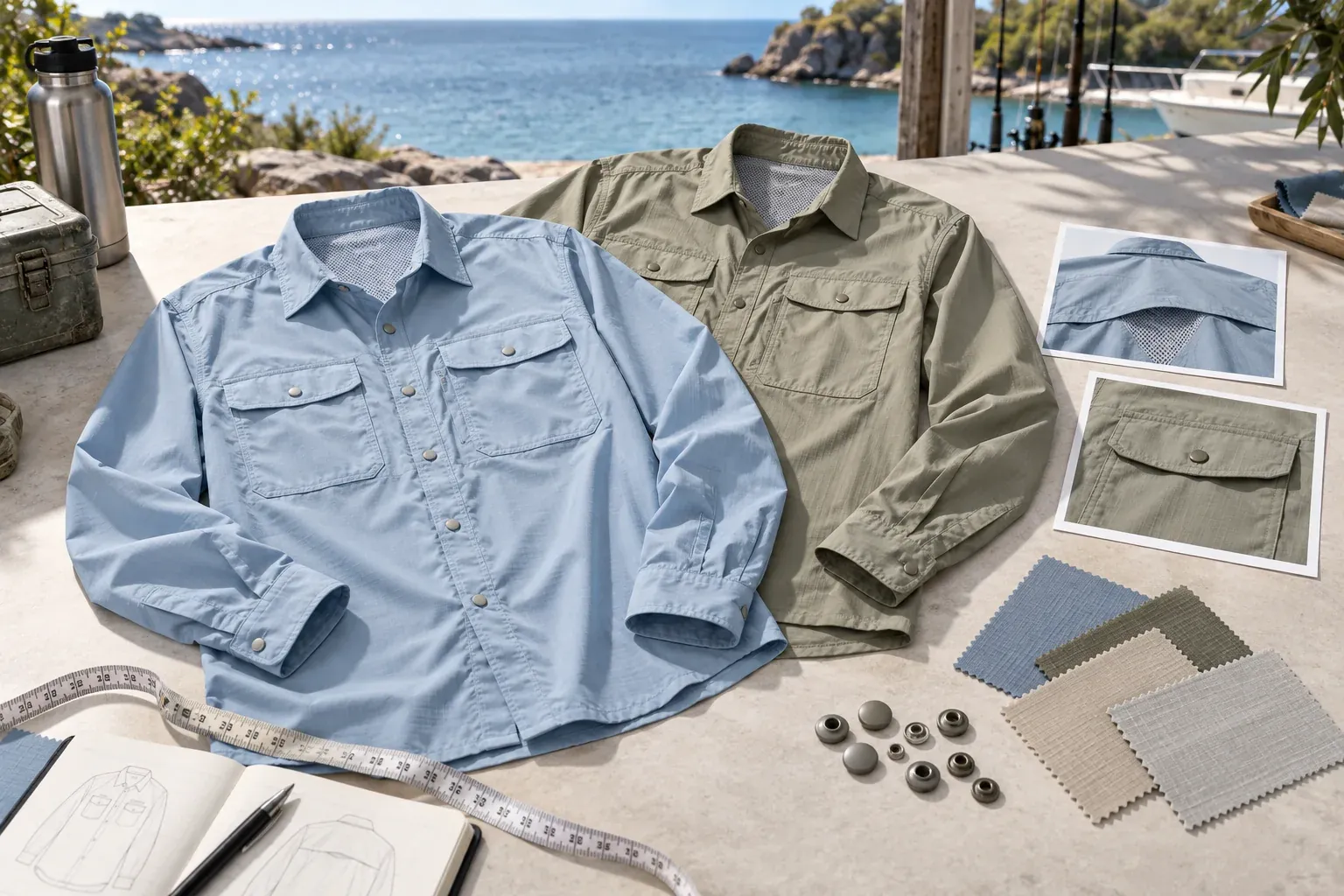
The hero image is an original editorial visualization created for this article. It does not depict any listed supplier’s factory or product.