
Women’s fishing shirts should be designed around the wearer, the fishing conditions, and the movement the garment has to support. A smaller men’s shirt rarely solves the fit problem. The shoulder shape, chest allowance, waist suppression, hip room, sleeve reach, hood, and hem all need to work together before a brand approves bulk production.
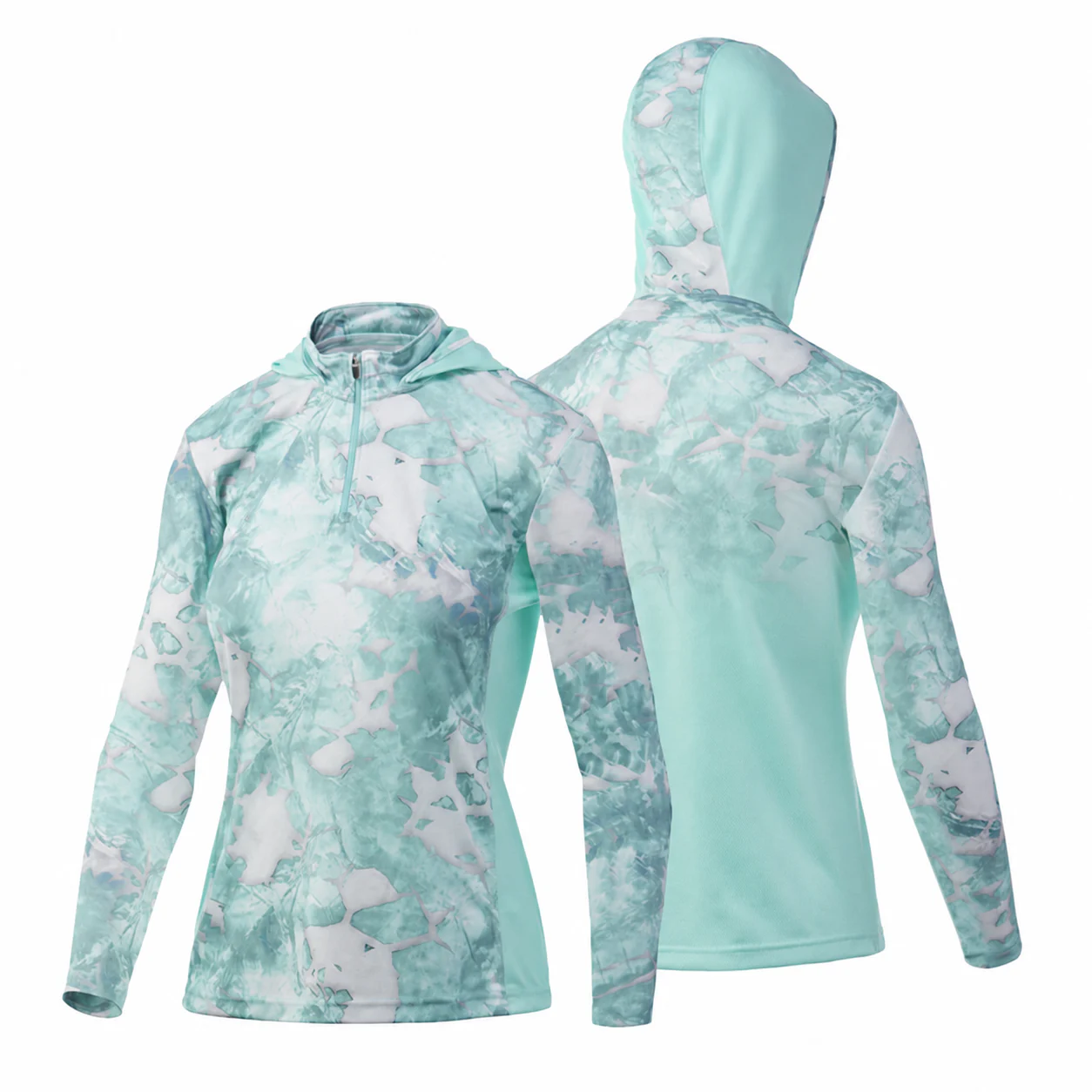
The two hooded styles shown here point to two useful product directions. One uses a quarter zip, shaped side panels, and a soft aqua print. The other adds a built-in face cover and a stronger blue-water graphic. Both can become custom women’s fishing shirts, but they require different pattern, fabric, ventilation, and artwork decisions.
What makes women’s fishing shirts different?
Women’s fishing shirts use a pattern shaped for women’s body proportions rather than a men’s pattern reduced by one or two sizes. The main differences may include chest shaping, a narrower shoulder, a defined waist, more room through the hip, adjusted sleeve length, and a hem that stays in place when the wearer casts, sits, or bends.
That does not mean every women’s style should fit close to the body. A relaxed fishing shirt may be the right choice for charter crews, guides, or customers who layer a tank top underneath. The important part is intentional grading. The fit should remain recognizable from the smallest size through the extended-size range.
The aqua shirt makes this visible. Its solid side panels run from the underarm toward the hem, while the printed front carries the main visual story. Those panels can help shape the body without breaking the artwork across a dart. They can also use a mesh or stretch fabric if the approved construction and performance requirements support it.
For a private label program, define the fit before discussing colors. Start with four questions:
- Should the body be fitted, semi-fitted, or relaxed?
- Will the shirt be worn alone or over another layer?
- Does the target customer need standard, petite, tall, or extended sizing?
- Which existing garment best represents the desired fit?
A reference garment is often more useful than a mood board. It gives the pattern maker real chest, waist, hip, body-length, and sleeve measurements to compare during sampling.
Fit has to survive a casting motion
A standing photo cannot prove that a fishing shirt fits. The sample needs to be checked with both arms reaching forward, one arm raised, the torso rotated, and the wearer seated. These movements expose problems that disappear in a normal fitting-room pose.
Watch the shoulder first. If the armhole is too low or the upper sleeve is too narrow, the body lifts when the wearer casts. If the chest is too tight, the zipper and neckline may pull. If the shirt is shaped aggressively at the waist, the hem can ride up under a life jacket or backpack strap.
Raglan sleeves are common in performance fishing shirts because the seam can allow a clean visual line from the neckline to the underarm. A set-in sleeve can still work well, especially for a more polished quarter-zip or polo, but the shoulder width and sleeve cap need careful testing.
Sleeve reach matters too. A sleeve that looks correct with the arms down may expose the wrist during a cast. Brands adding thumb holes should review opening position, edge finish, and size grading instead of copying one measurement across the range. Our article on thumb hole design for custom fishing hoodies covers those production checkpoints in detail.
Fabric should match heat, coverage, and fit
The best fabric for women’s fishing shirts depends on the climate and product position. A hot-weather sun shirt usually needs a light, quick-drying knit with enough stretch for movement. A cooler-weather top may use a denser knit, brushed inner face, or an outer layer with more wind resistance.
Do not choose fabric from composition alone. Two fabrics labeled 100% polyester can feel and perform very differently because of yarn, knit structure, weight, finishing, and air permeability. A polyester-spandex blend may give a shaped women’s cut more recovery, but extra stretch also changes how the garment fits and how much ultraviolet radiation can pass through when the material is extended.
Side or back panels create another decision. A more open mesh can increase airflow, yet the mesh may not support the same sun-protection claim as the main body. Place ventilation where it helps, then confirm what the finished product can honestly claim.
If UPF is part of the product brief, ask for evidence tied to the approved material. The AATCC TM183 test method covers measurement of ultraviolet radiation transmitted or blocked by fabrics under stated conditions. A report for one fabric, color, or construction does not automatically cover every future version.
Our UPF50+ and UPF30 fishing shirt comparison explains how to read the rating and check whether the report matches the material being ordered.
The same distinction applies to garment coverage. ARPANSA’s sun-protective clothing guidance explains that clothing protects only the area it covers and that wetness, stretch, wear, and chemicals may affect protection. A long sleeve and hood add coverage, but the product claim still needs the right test basis.
Hood, quarter zip, or built-in face cover?
These details change more than the appearance of women’s fishing shirts. They affect heat release, head movement, layering, sewing time, and how the customer uses the garment.
Quarter zip. A short zipper lets the wearer open the neckline when conditions get hot. The zipper length, puller, backing, and top finish need to avoid rubbing the neck. On a sublimated design, the artwork should be aligned before the zipper is installed.
Standard hood. Hood depth and face opening should work with a cap, sunglasses, and tied-back hair. The hood should turn with the head without pulling the front neck backward. A hood copied from a casual sweatshirt is often too heavy or too loose for open-water use. The same fit checkpoints apply across a wider custom fishing hoodie program.
Built-in face cover. A face panel gives more coverage and removes the need for a separate gaiter. It also creates new fit risks around the nose, ears, and neck. The panel needs enough stretch and recovery to sit in position without pressing hard against the face.
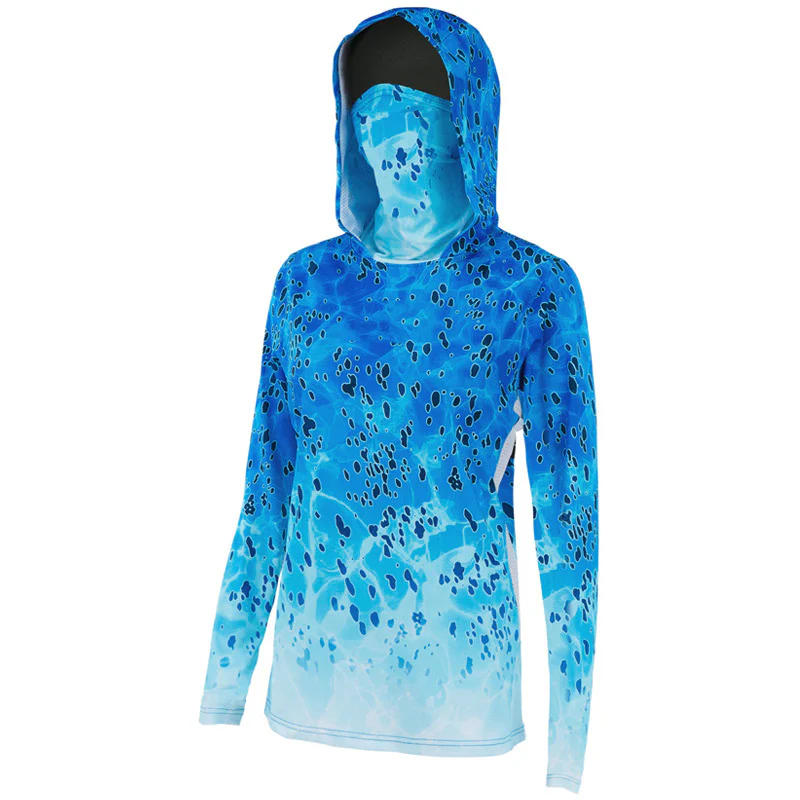
The blue style combines a hood and face cover in one continuous graphic. That creates a strong retail image, but the face panel should not be approved from appearance alone. Sample it on more than one head size. Check breathing comfort, sunglasses fogging, peripheral vision, and whether the panel stays up after repeated stretch.
Brands deciding between coverage formats can also compare our separate sun hoodie and UPF fishing shirt analysis.
Sublimation works best when the panels are planned together
Full sublimation is a practical option for women’s fishing shirts with water patterns, fish graphics, sponsor marks, or color gradients. The dye enters suitable polyester fibers, so the print does not create a heavy surface layer like a large transfer.
The artwork still has to respect the garment pattern. Side seams, sleeve seams, zipper openings, hood seams, and face-cover joins can interrupt a graphic. A pattern that looks continuous on a flat mockup may shift after sewing because fabric stretches and seam allowances consume part of the print.
Use the panel map to decide which details must align and which can tolerate movement. A centered logo needs tighter placement control than an abstract water texture. Small text should stay away from high-stretch areas and seam edges. If the program includes sponsor logos, confirm minimum size and placement before the artwork is nested for printing.
Solid contrast panels can make production easier. On the aqua shirt, the mint side and back panels provide visual breathing room around the print. They also create stable areas for a heat-transfer logo, small embroidery, or a private label identity, depending on fabric and brand position.
For more detail on print selection, see our comparison of embroidery and sublimation for fishing shirts.
Size grading should not stop at the bust measurement
A useful women’s fishing shirt size chart covers more than chest width. It should include body length, shoulder or raglan seam reference, waist, hem or hip width, sleeve length, cuff opening, neckline, hood depth, and face-cover height where applicable.
Grading each point by the same fixed amount is rarely enough. The chest, waist, and hip may need different grade rules. Hood and face-cover dimensions may also change more slowly than the body. Stretch percentage and intended compression affect how those measurements feel when worn.
Before bulk production, compare the approved sample with the written measurement table. Then record tolerance and measurement method. This prevents a repeat order from drifting simply because a different operator measures the shirt in a different position.
Our fishing apparel size chart provides reference measurement logic, but a women’s program should use its own approved grading rather than inherit a men’s table unchanged.
What should a brand confirm before sampling?
Turn the product idea into a short development brief before asking for a quote. This makes fabric recommendations and sample pricing much more useful.
| Decision | What to specify |
|---|---|
| Product format | Crew neck, quarter zip, hooded shirt, face-cover hoodie, polo, or button-up |
| Intended use | Offshore, freshwater, kayak, charter crew, tournament, resort, or lifestyle retail |
| Fit direction | Fitted, semi-fitted, relaxed, layering allowance, and reference garment |
| Fabric | Target weight, stretch, hand feel, airflow, drying expectation, and required test evidence |
| Size range | Base size, smallest and largest sizes, extended-size plan, and target market |
| Artwork | Full sublimation, solid panels, logo locations, sponsor marks, and color references |
| Construction | Hood, zipper, face cover, ventilation, thumb holes, hem, seams, and label package |
| Order plan | Sample quantity, first bulk quantity, delivery destination, and target date |
Once those decisions are clear, a custom fishing shirt manufacturer can recommend a base pattern or build a new one. The sample then has a real job: prove the fit, movement, construction, and artwork before the order scales.
Are women’s fishing shirts different from unisex shirts?
They can be. A unisex shirt normally uses one straighter body block across the size range. A women’s fishing shirt can use adjusted shoulder, chest, waist, hip, sleeve, and body-length proportions. Neither format is automatically better. The right choice depends on the customer, fit promise, size mix, and whether the brand can manage two separate patterns.
Do women’s fishing shirts need UPF 50+?
Not every fishing shirt must carry the same rating. If a brand markets a specific UPF claim, the claim should be supported by a relevant report for the approved material and test conditions. Coverage, wetness, stretch, color, and garment construction should be reviewed alongside the rating.
Can a women’s fishing shirt include both a hood and face cover?
Yes. The hood and face cover can be separate pieces or an integrated construction. The sample should be checked for breathing comfort, head movement, cap and sunglasses compatibility, stretch recovery, and fit across the intended size range.
Can women’s fishing shirts use custom prints and private labels?
Yes. Suitable polyester styles can use full sublimation, while smaller identity details may use embroidery, transfer, screen print, or a combination. Neck labels, size marks, care labels, hangtags, packaging, and barcode requirements can also be developed through a custom labels and packaging program.
Women’s fishing shirts sell the promise of comfort and coverage on the water. The sample has to prove that promise. Set the fit, fabric, size grading, coverage details, and artwork rules early, then use the approved garment as the production standard for bulk orders and repeats.