Quick answer: Buy from a wholesale distributor when you need available fishing shirts in established styles. Use a local teamwear printer when an existing garment can be decorated to meet your brief. Work with a specialist factory when you need control over fabric, fit, construction, all-over artwork or private labels. The best route depends on the order you are placing.
Searching for a wholesale fishing shirt supplier brings together several different services. One business sells cartons of finished garments. Another prints your team logo on a shirt it buys elsewhere. A manufacturer develops and produces the garment from an agreed specification. Some suppliers offer more than one of these services.
Before comparing names or unit prices, decide what must change about the shirt and what can stay as it is. That decision makes the supplier search shorter and the quotations more useful.
In this guide: Compare the three routes · Choose by business need · Check the order scope · When EZ Fishing Wear fits.
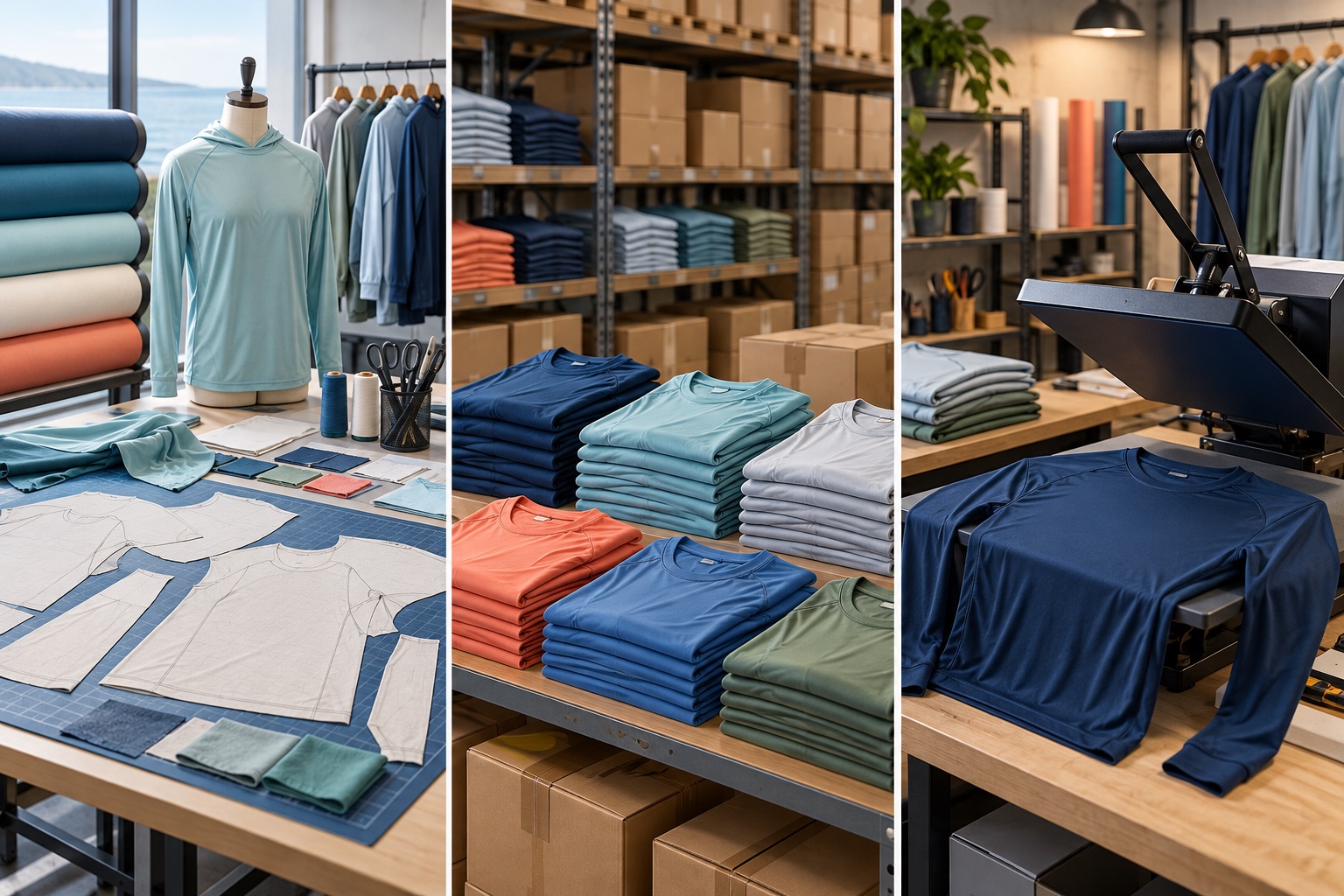
Three places to buy wholesale fishing shirts
The labels below describe the service you are buying. They do not establish quality on their own. A distributor may run a separate custom program, and a local decorator may also manage cut-and-sew orders. Ask which route applies to your quotation.
| Route | A practical starting point when… | What to establish before paying |
|---|---|---|
| Wholesale distributor | You want an existing shirt style and can work with the stock colors, measurements and available sizes. | Available stock by size, permission to resell or relabel, product evidence, replenishment and return terms. |
| Local teamwear printer | An available garment meets your needs and the main job is adding a logo, event artwork or team identity. | The exact base garment, decoration method, proof process, setup charges, replacement stock and delivery date. |
| Specialist apparel factory | You need to develop fabric, fit, panels, pockets, ventilation, all-over artwork, labels or a repeat production program. | Approved specification, samples, minimums, inspection plan, production responsibilities and shipment scope. |
Wholesale distributor: choose from an existing product
A distributor is worth investigating when your main problem is availability. A retailer may need a known product to fill a shelf, or a charter operator may be satisfied with an established sun-shirt style. You can assess the exact product before committing to a larger purchase.
Check the size-level stock position rather than accepting a total inventory number. A supplier may have enough pieces overall but not the sizes your order requires. Also ask whether the next delivery will use the same garment specification. A stock code alone is a weak basis for a repeat order if the underlying product can change.
If you plan to add a label or resell the shirts under your own brand, obtain written permission and the relevant labeling information first. Do not assume that a wholesale price includes relabeling rights or a private-label service.
Local teamwear printer: customize the available garment
A local printer or decorator can be a useful starting point for a club, guide service or small event that already likes an available shirt. Local sample access and a single point of contact may simplify the process. A nearby business can still need time to procure blanks, schedule decoration and approve artwork, so confirm the finished delivery date.
Ask which processes are being quoted. Heat transfer, embroidery, screen printing and sublimation have different material and design requirements. A decorator that supplies cut-and-sew sublimated jerseys is offering a different program from one applying a chest transfer to stocked garments. The location of the business does not answer that question.
Approve the decoration on the intended fabric. A screen preview cannot show the finished hand feel, backing, seam interference or the effect of pressing on the garment. See our embroidery and sublimation comparison for a closer look at decoration choices.
Specialist factory: develop the product specification
A specialist factory becomes relevant when the available garments do not meet the brief. You might need a different sleeve length, a women’s pattern, a vented woven back, a fabric selected for your market, or coordinated labels and retail packaging.
Those decisions become a written specification and an approved sample. They also create development work and minimums. Factory sourcing fits a buyer who can review materials, measurements, artwork and samples before production. If you only need a handful of shirts immediately, ask about available stock or local decoration before starting a new manufacturing program.
Match the buying route to your business
Use these examples as a first filter. Confirm availability and capability with the suppliers you approach.
| Your situation | Investigate first | What could change the decision |
|---|---|---|
| A retailer needs ready-made shirts to sell soon. | A wholesale distributor with the required size-level stock. | You need exclusive products, a different fit or a private-label collection. |
| A small team likes an existing shirt and needs a chest logo. | A local decorator that can supply and test that exact garment. | You need all-over sponsor graphics, multiple individual names or a custom cut. |
| A new brand wants its own fabric, fit, labels and repeat orders. | A specialist factory with relevant development and production evidence. | The launch quantity or deadline cannot support development and the stated minimums. |
| An event organizer needs a large coordinated team order. | Compare a teamwear provider and a specialist factory against one brief. | The winner may depend on roster control, sample approval, landed cost and delivery responsibility. |
An overseas supplier is not automatically a factory, and a local supplier is not automatically the manufacturer. If an intermediary is involved, ask who makes the garments and who approves changes. Our factory versus trading company guide explains that separate question.
Compare the complete cost and order scope
A usable comparison starts with the same requirements: garment category, fabric, size range, decoration, quantity, labels, packaging, destination and required arrival date. If one quotation uses a stocked polyester blank and another includes a new pattern and all-over print, the unit prices describe different products.
Record what is included, excluded or still unconfirmed. Sample fees, artwork preparation, size-set development, testing, individual packing, inspection and freight may appear as separate items or be built into the unit price. Neither format is inherently better; the scope must be visible.
For an international order, request the quoted delivery term and named location. Identify who arranges transport, handles import formalities and pays the applicable destination charges. ICC’s Incoterms® overview explains the role of these rules in allocating buyer and seller responsibilities. Obtain shipment and import estimates for your actual route before treating a factory quote as a delivered price. Our logistics and shipping page describes the information needed for shipment planning.
Six questions that reveal how the order will be handled
1. Which exact garment or specification are you quoting?
For stock, request the product code and current size chart. For custom production, request the fabric code or description, measurements, construction and decoration scope. Keep the reference in the quotation so a later substitution is visible.
2. Can I assess a relevant sample before the full order?
A stocked shirt can establish the base garment. A custom sample should show the proposed material and construction, with any substitutions clearly declared. An unrelated showroom sample demonstrates much less about your future order.
3. Who controls manufacturing and specialist processes?
Ask which business performs cutting, sewing, printing, inspection and packing. Understand any partners and who resolves defects. A clearly described production relationship is more useful than an unsupported “factory-direct” label.
4. Does the performance evidence apply to this product?
If UPF or another tested property matters, compare the report’s specimen description and test scope with the proposed material or garment. A report for a different fabric, finish or color should be explained. Do not treat a generic certificate image as approval for every product in the catalog.
5. What must be approved before the delivery plan is confirmed?
Identify the material approval, sample approval, artwork deadline, size breakdown and payment milestones. A production estimate that assumes instant approvals may not protect a fixed event date. Ask for the dependencies as well as the planned dates.
6. What happens when I reorder or find a problem?
Ask what records are retained, whether the same base garment or material can be supplied again, and how shortages or defects are handled. Agree on the response process and acceptance criteria before the order, while the requirements can still be changed.
Send one clear brief to every shortlisted supplier
You do not need every technical decision settled to begin a conversation. You do need to distinguish fixed requirements from open choices. Copy this brief into your first inquiry:
| Brief item | What to send |
|---|---|
| Buyer and end use | Brand, retailer, club, charter crew or event; target customer and market. |
| Product | Long-sleeve shirt, hoodie, polo or button-up; a reference image or garment if available. |
| Quantity | Pieces per style and colorway, estimated sizes and whether repeat orders are expected. |
| Customization | Stock or custom fit, fabric expectations, logo locations, all-over print, labels and packaging. |
| Evidence needed | Samples, measurement records and any product-specific performance reports. |
| Delivery | Destination city and country, plus the date the shirts must be in hand. |
| Open decisions | Details you need the supplier to propose; identify these explicitly. |
For a detailed manufacturer assessment after shortlisting, use our fishing shirt manufacturer evaluation guide.
When EZ Fishing Wear is a suitable option
EZ Fishing Wear is an option for buyers developing custom fishing shirts, polos, sun hoodies, button-ups and related apparel. Our directly operated production facility is in Dongguan, China. Yiwu Yihui Trading Company is our export entity for overseas business and international shipments. You can review our company and production disclosure and OEM manufacturing capabilities before sending a brief.
Our starting MOQ for custom fishing shirts is 100 pieces per style and colorway. Sizes can normally be mixed within an approved style. Fabric, custom-dyed colors, trims, decoration and packaging may affect the final minimum. The complete specification is reviewed before we quote. These minimums apply to EZ Fishing Wear; other suppliers set their own conditions.
A custom program is particularly relevant when you need control over garment development, private labels or consistent repeat production. For an immediate purchase of a few ready-made shirts, a stocked distributor or local retailer is a better starting point. For a small logo-only order, compare local decoration against any custom manufacturing option.
Send us the shirt type, quantity, customization, destination and required arrival date. We can review the manufacturing route and the missing decisions with you. Request an OEM project review, or explore custom fishing shirts and private-label fishing apparel.
Wholesale fishing shirt questions
Is a factory always cheaper than a local printer?
No. Compare the same garment and complete delivered scope. Development, samples, decoration, labels, inspection, freight and import costs can change the outcome. A local printer using available garments may be practical for a small or urgent order.
Can a wholesaler supply private-label fishing shirts?
Some offer private-label or custom programs; others sell only existing products. Ask whether they can change the fabric, pattern and construction or only add decoration and labels. Confirm who approves samples and controls repeat production.
Can I order different sizes together?
Ask each supplier. A stock order depends on the available size inventory and any pack requirements. For EZ Fishing Wear’s custom shirt programs, sizes can normally be mixed within one approved style and colorway; different fits or constructions must be confirmed in the quote.
Where should a tournament organizer begin?
Start with the shirt type, approximate quantity, event location and actual in-hands date. Then organize sponsor artwork and the final roster. Our tournament fishing shirt order checklist includes the working templates.
Written by Victor, Founder of EZ Fishing Wear. Supplier models are described as buying options, not guarantees of price, quality or availability. EZ Fishing Wear’s company and order conditions are linked above so buyers can check their fit for a specific project.