
Quick answer: To budget for custom fishing shirts, multiply the confirmed unit price by the order quantity, then add development, testing, inspection, packing and delivery charges that are not already included. Keep the fabric, construction, artwork, size range and delivery basis consistent when comparing suppliers or quantities.
A bulk price becomes useful when you know exactly what it buys. Two long-sleeve fishing shirts can use different fabrics, patterns, print methods and packaging. A low unit price for one specification cannot establish the cost of another.
This guide gives you a way to build an order budget from written quotations. It does not publish an industry average or an EZ Fishing Wear price list. Your product and current commercial terms need to be reviewed before a payable price can be confirmed.
In this guide: Set the reference shirt · Separate the costs · Compare quantities · Use the worksheet · Request a quote.
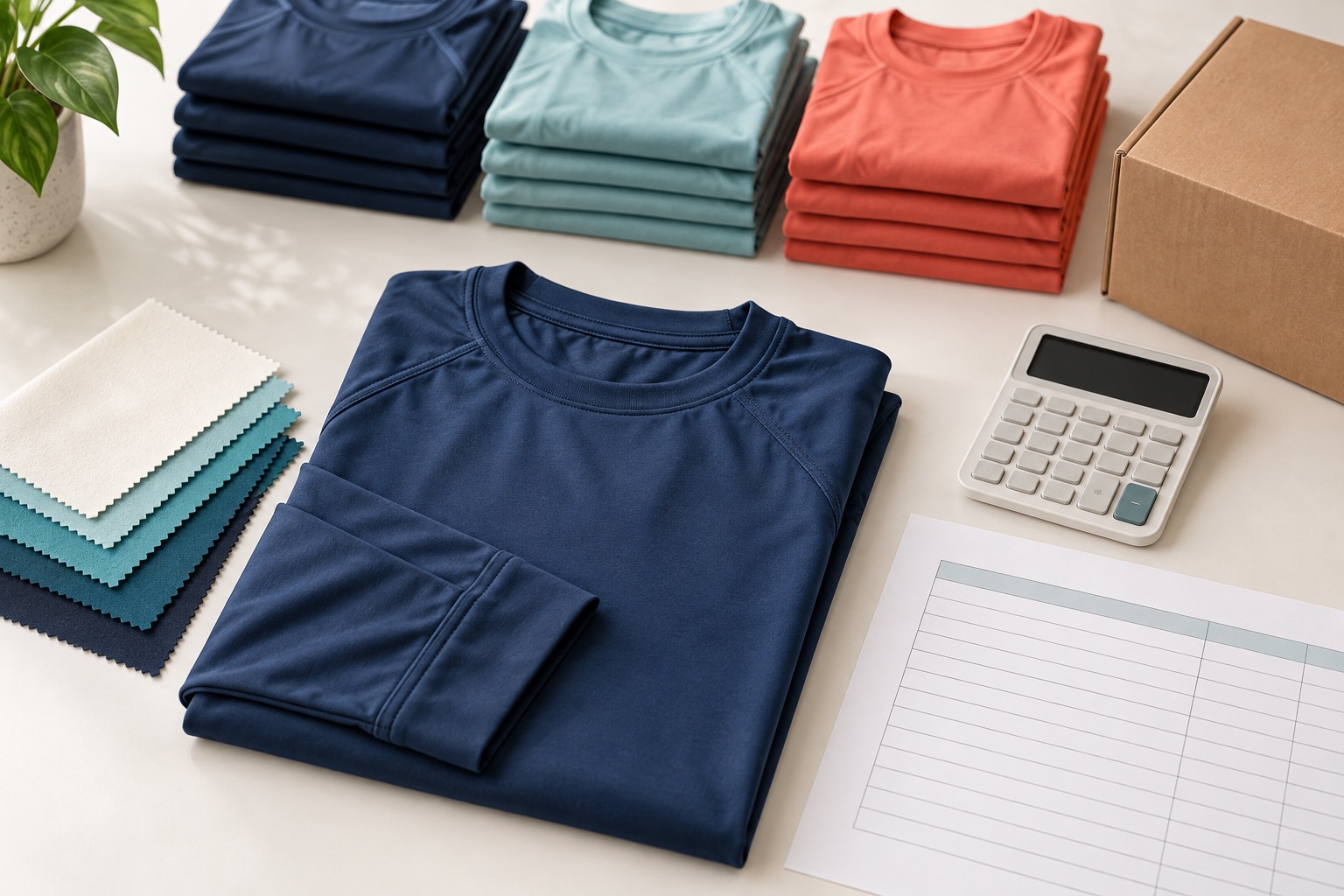
Define the reference shirt before requesting prices
Write one reference specification and send it to every shortlisted supplier. Mark the decisions you have not made so the factory can quote an option rather than silently choose one for you.
For example, a request for a long-sleeve sublimated fishing shirt should identify the material, construction, artwork route, size range and packing. The table below is a brief structure. It does not prescribe the same fabric or fit for every program.
| Quote input | Detail to fix or ask the supplier to propose |
|---|---|
| Product and use | Crew-neck fishing jersey, sun hoodie, polo or button-up; target wearer and market. |
| Fabric | Material reference or composition, finished weight, stretch, color and required evidence. |
| Construction | Fit, sleeves, seams, collar or hood, pockets, vents and other specified details. |
| Decoration | Full sublimation or placement decoration; logo areas, names, numbers and variations. |
| Order split | Pieces per style and colorway, plus the proposed size and fit breakdown. |
| Brand presentation | Main and care labels, hangtags, barcode requirements and individual packing. |
| Delivery | Named destination, required arrival date and requested delivery basis. |
A stock blank with a chest print and a newly developed all-over shirt are different jobs. If both could meet your needs, ask for two identified options and evaluate the tradeoffs. Our wholesale fishing shirt sourcing guide helps you select the supplier route first.
Separate development, production and delivery costs
Build the budget in three groups. Every charge should appear once, either inside the unit price or as a separate line. Record “included,” “separate,” “not applicable” or “unconfirmed” instead of leaving ambiguous blanks.
| Group | Possible cost items | Question to resolve |
|---|---|---|
| Development | Pattern work, sample making, artwork preparation, print strike-offs, size-set development and sample courier. | What is covered by the initial fee, and what changes could trigger another charge? |
| Bulk production | Fabric, cutting, sewing, decoration, labels, trims, packaging and agreed production checks. | Which components are already in the per-shirt price? |
| Additional order and delivery charges | New tests, independent inspection, freight, insurance, clearance, destination charges and final delivery. | Who arranges and pays each item, and what is still only an estimate? |
Not every project needs every item. A repeat order with unchanged files may need less development, while a new fabric or pattern can require additional work. Ask the supplier to describe the actual scope rather than apply an assumed setup allowance.
Keep initial fees and any credits visible
If a sample charge is credited against a later order, record the conditions and the invoice where the credit will appear. Until that credit is agreed, retain the sample payment in the cash plan. Sample courier, additional revisions or testing may be treated separately.
Use the same currency and delivery scope
Record the quote currency, date and validity. If you convert currencies for comparison, record the conversion date and rate separately. A later payment can differ from that planning estimate.
For an international order, ask for the delivery term and named place and identify any buyer-paid costs beyond it. ICC explains that Incoterms® rules allocate delivery tasks, costs and risks between buyer and seller. A freight amount without a defined destination and scope is an incomplete basis for a delivered budget. Confirm route-specific import and destination charges with the parties handling the shipment. Our shipping planning page lists the information needed for a freight assessment.
Calculate the complete order budget
Start with the quantity you are actually purchasing. Use amounts in one currency and avoid adding charges already included in the unit price.
Planning formula:
Order budget = quantity × quoted unit price + separate development charges + separate order charges + buyer-paid delivery and destination charges − confirmed credits.
Budget per ordered shirt = order budget ÷ ordered quantity.
This is a purchasing budget, not a promise about the eventual margin on retail sales. Keep contingency amounts, provisional freight estimates and unresolved charges separately identified. An unconfirmed cost is not zero. Taxes and other destination amounts need the treatment appropriate to the buyer and shipment; do not copy a universal percentage into every order.
Also record when payments are due. A budget that includes the whole order can still hide a cash-flow problem if development payments, a production deposit and a shipping balance fall before your own sales receipts.
Compare 100, 300 and 500 pieces on the same basis
Request a written quote at each quantity you are considering. Hold the garment and service scope constant. Ask the supplier to identify any assumption that changes, such as material availability, packing, order splits or the shipment method.
| Quantity scenario | Production amount | What else to confirm |
|---|---|---|
| 100 pieces | 100 × the unit price quoted for 100 pieces. | Development and delivery charges for this run; eligibility for the requested specification. |
| 300 pieces | 300 × the unit price quoted for 300 pieces. | Whether the same fabric, design and included services remain in the quote. |
| 500 pieces | 500 × the unit price quoted for 500 pieces. | Shipment size, payment schedule, inventory commitment and any changed conditions. |
The quantities above are comparison scenarios, not published prices or automatic discounts. If the same fixed development fee applies to all three runs, its per-piece allocation decreases as quantity rises. The garment unit price and freight still need their own quotations. A lower cost per piece can come with a higher total commitment and more unsold inventory.
Check the split as well as the total. Three hundred shirts in one approved style and colorway differ from three hundred spread across several styles, fabrics and artwork programs. Each split can introduce new minimums or setup work.
At EZ Fishing Wear, the starting MOQ for custom fishing shirts is 100 pieces per style and colorway, with sizes normally mixed within an approved style. Fabric, custom-dyed colors, trims, decoration and packaging may affect the final minimum. We confirm the full specification before quoting; a total order quantity alone does not establish eligibility.
Use a quote worksheet to find missing costs
Give the worksheet a specification ID and place both suppliers’ quote references next to it. Then compare the amounts and the assumptions together.
| Comparison line | Quote A | Quote B | Before comparing totals |
|---|---|---|---|
| Garment, material and artwork | Record the identified specification. | Record the identified specification. | Resolve substitutions and differences. |
| Unit price and ordered pieces | Record both values and currency. | Record both values and currency. | Use the actual order split. |
| Separate development and order fees | Itemize the stated charges. | Itemize the stated charges. | Remove double counting and identify omissions. |
| Delivery and destination scope | Record included and buyer-paid items. | Record included and buyer-paid items. | Compare to the same destination. |
| Quote date, validity and conditions | Copy from the written quotation. | Copy from the written quotation. | Reconfirm expired or provisional amounts. |
Useful follow-up questions are specific: “Does this price include our woven neck label?” or “Is the freight estimate to our warehouse address?” An apparently cheaper quote may still be the better choice, but you need to know what produces the difference.
Discuss cost reductions through specific choices
Bring a target budget and ask which decisions could change the quote. Preserve the features that matter to the intended wearer and evaluate each proposed change before approval.
| Choice to discuss | Why it may affect the quote | What the buyer should review |
|---|---|---|
| Use an available material or color | May reduce separate sourcing or custom-color work. | Fabric feel, specification, appearance and supporting evidence. |
| Launch fewer styles or colorways | May reduce the number of development and production setups. | Whether the reduced assortment serves the launch. |
| Simplify trims or retail packing | Removes identified components or handling steps. | Function, brand presentation and distribution requirements. |
| Finalize artwork before release | Can avoid rework caused by later changes. | Sponsor approvals, legibility and the actual panel map. |
| Plan the delivery window earlier | Gives time to compare feasible shipment options. | The complete schedule and the actual in-hands requirement. |
Ask for the revised specification and price together. A cost change should be traceable to an approved product decision. The sample approval checklist helps confirm that the revised product still meets the brief before bulk production.
Send a brief that can be priced
For an EZ Fishing Wear project, send the garment type or reference, quantity per style and colorway, size range, fabric expectations, artwork status, labels, packing and destination. Add the date the shirts must be in hand and identify anything you want us to propose.
We can review the manufacturing route and clarify the quote scope from those inputs. A discussion can begin with a reference garment or annotated image; the final specification and commercial conditions must be settled for a confirmed production price. Request an OEM project quote or review our custom fishing shirt options.
If you are deciding between a local supplier and overseas manufacturing for Australia, our Australia sourcing cost guide addresses that market-specific comparison. For scheduling and minimums, use the MOQ and sampling guide.
Bulk quote questions
How much do custom fishing shirts cost in bulk?
The amount depends on the defined garment, quantity, order split and delivery scope. Ask for a current written quote and use the worksheet to add separately payable development and shipment costs. This article does not establish a universal per-shirt price.
Are samples free or credited against production?
Confirm the individual supplier’s policy and the conditions in writing. If a credit is agreed, identify the qualifying order and invoice. Additional samples, courier charges and testing may have separate terms.
Do individual names and numbers cost extra?
Ask whether variable-data preparation, proofing, printing and packing are included. The answer depends on the production route and order complexity. Send the number of variations when requesting the quote; our tournament order guide includes roster and sponsor templates.
Can a repeat order use the original unit price?
Use the approved product record as a starting point, then obtain a current quote for the new quantity, materials and delivery requirement. An earlier price does not establish current availability or cost.
Written by Victor, Founder of EZ Fishing Wear. Company minimums are subject to the complete specification. Cost tables are planning frameworks; payable prices and commercial conditions come from the confirmed quotation.