
Quick answer: Before bulk production, approve the brand and size labels, textile and care information, hangtags and SKU data, individual packaging, and carton plan. Tie them to one style, order and file version. Review the finished application and packed sample, then record who approved each item and what remains open.
A correct shirt can still arrive with the wrong size sticker, outdated care copy or a hangtag belonging to another color. Preventing that mismatch requires one connected approval record, from the information source to the packed garment.
This checklist focuses on adult fishing shirts for the US retail market. Other destinations, children’s products and individual retailers need their own review. The tables organize procurement decisions; they do not certify a product or replace the obligations of manufacturers, importers and other responsible businesses.
What Should You Approve Before Bulk Production?
Use this overview to assign each component an owner and a reference. A picture of a label proves little unless the team knows which garment and order it belongs to.
| Item | Confirm before release | Keep as approval evidence |
|---|---|---|
| Brand and size labels | Copy, material, dimensions, color, fold, attachment, position and size mapping | Dimensioned artwork and the label applied to the sample |
| Textile and care information | Supported wording, applicable market, placement and durability | Final copy, supporting records and application review |
| Hangtags and product data | Style, color, size, SKU, buyer-assigned barcode data and supported claims | Artwork, data master and printed proof |
| Individual bag or box | Material, internal size, fold, closure, stickers and applicable warnings | One complete packed sample |
| Carton and packing list | Assortment, quantity, carton numbers and shipping marks | Carton artwork and allocation sheet |
| Version control | Order, files, quantity, approver, date and change scope | Dated approval record and retained references |
The buyer identifies the sales channel and supplies or confirms brand and product data. The factory checks the proposed application against the actual garment and production process. Approval responsibilities should be explicit; a buyer’s signature does not remove anyone’s legal duties.
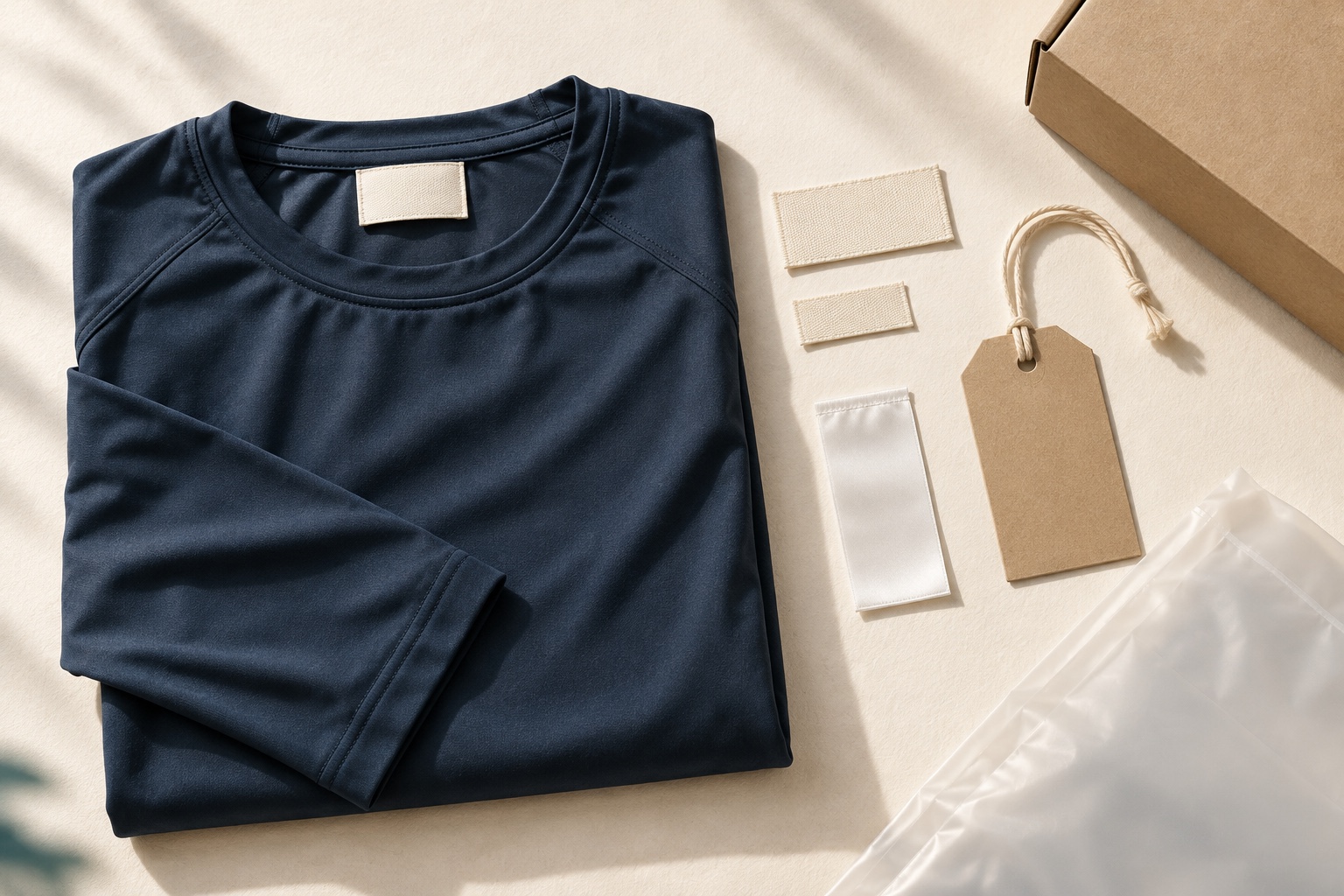
What Information Should the Buyer Prepare First?
Start with a short brief before designing the components. Send the target country, adult garment category, sales channel, style reference, materials, colors, size range and quantity. Add authorized brand artwork and any retailer or warehouse instructions.
Record where the composition, origin, business identity and care information will come from. If a field is uncertain, mark it for confirmation instead of filling it from a similar shirt.
| Preparation check | Status to record |
|---|---|
| Sales market, channel and receiving requirements | Ready / pending / not applicable |
| Style, materials, colors, sizes and quantity | Ready / pending / not applicable |
| Brand files and permission to use them | Ready / pending / not applicable |
| Label information and supporting sources | Ready / pending / not applicable |
| SKU data and packing instructions | Ready / pending / not applicable |
Use the private-label development brief to connect these details to the garment specification. The label project should follow the same style identity as the shirt.
How Do You Approve Neck Labels and Size Identification?
Compare a woven label, printed label or transfer using the actual fabric and intended application. Ask to see the proposed dimensions, finish and attachment. A suitable option for a woven collar may behave differently on a thin stretch knit.
Show position and orientation on a drawing, with measurements from a named reference point. Specify folds, seam allowance and which size uses each size mark. Check the applied sample from inside and outside for rough edges, puckering, show-through and interference with the neckline.
If wash observations are part of approval, record the procedure and what changed. Do not treat an unrecorded wash or a component photograph as proof of long-term performance.
Keep decorative placement separate from required information placement. For US garments with a neck, the FTC places country-of-origin identification on the front of a label at the inside center back of the neck, midway between the shoulder seams or close to another label attached there. A side-seam care label does not automatically meet that location requirement. Confirm the final arrangement using the FTC textile labeling guide.
What Must Be Checked on Content, Origin and Care Labels?
Check the wording against the finished product and its records. The FTC textile guide explains fiber disclosure, country of origin and responsible-business identification. Imported origin marking also involves Customs requirements; review the actual sourcing and manufacturing route before printing.
For business identification, the FTC RN FAQ permits an appropriate business name instead of an RN. The trade name on a logo is not automatically the qualifying business name. Verify any RN and its holder; do not insert a placeholder number into production artwork.
Care instructions need reliable support for the complete garment, including decoration and trims. The FTC care-labeling guide requires secure permanent attachment and readability through the product’s useful life. If packaging obscures the information at sale, provide the additional display described in that guidance. Do not simply copy a washing instruction from another fabric.
Use a working copy checklist, not a ready-to-print label:
- Fiber declaration: confirmed wording and material source record.
- Origin: confirmed wording, basis and approved location.
- Business identity: verified name or applicable RN and source.
- Care: supported instructions, attachment and readability review.
Any blank field holds that part of the approval open. Decide who will resolve it and what evidence they must return.
How Do You Keep Hangtags, SKUs and Barcodes Consistent?
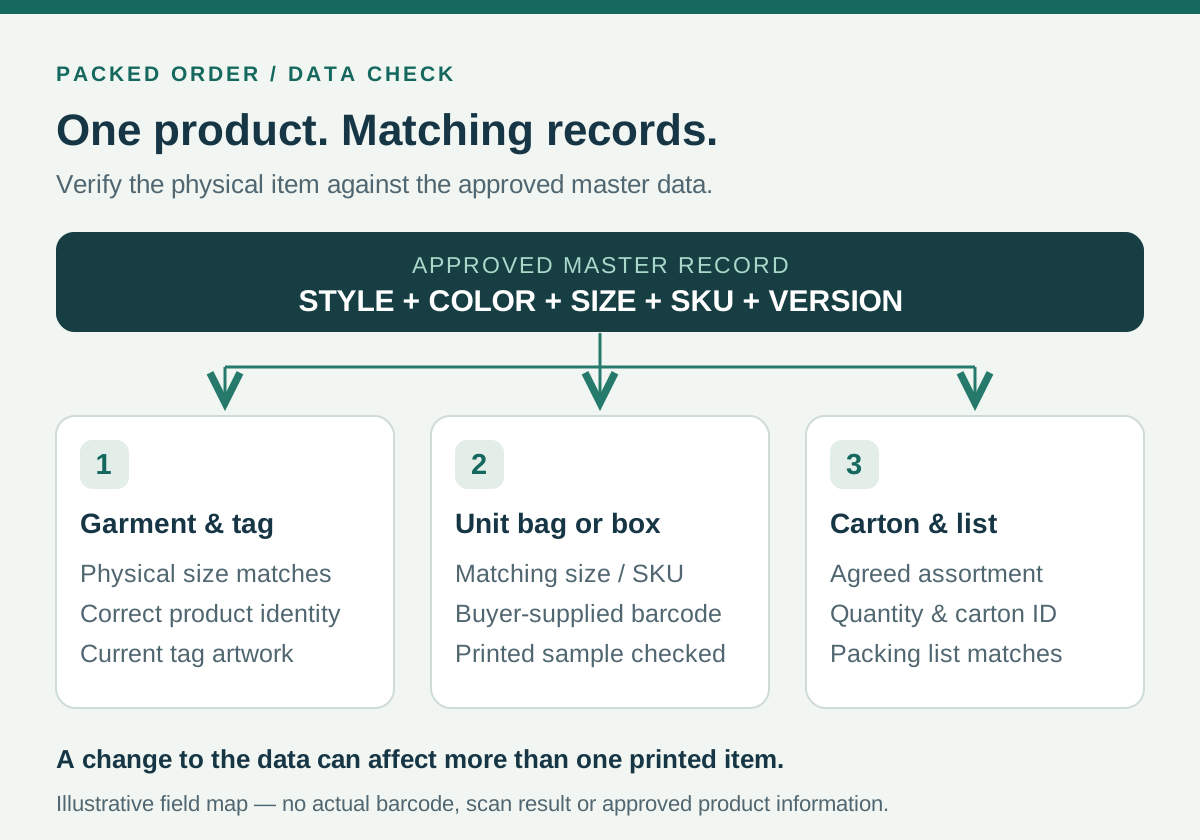
Build one master with a row for each saleable style, color and size combination. Include the buyer’s SKU, approved barcode data, artwork version and packing allocation. Generate hangtags, bag stickers and carton information from that version.
An illustrative mismatch: the master identifies a navy medium, while its bag sticker says large. The fix is to reconcile the physical garment, attached size mark and product record. A good-looking sticker alone cannot resolve it. This example contains no usable product identifier.
Approve tag dimensions, stock, finish, hole, fastener and attachment position. Inspect the actual printed proof at production size. Check that its barcode scans to the intended item under the buyer’s receiving process; a readable design preview is not a scan result or formal barcode verification.
UPF, recycled-content and other claims need their own supporting records and applicable scope. Remove inherited claims from a template until they have been reviewed for the current garment. Use the sun-protection buying guide to connect these questions to material selection.
What Should Be Confirmed on Bags, Boxes and Cartons?
Approve a folded garment inside the proposed bag or box. Check internal dimensions, closure, material, print, insert placement and which identifiers remain visible. The package should accommodate the approved range without bending tags or forcing the garment into a different fold.
Check warning copy, bag specifications and receiving requirements for the destination and channel. One retailer’s instructions should not be presented as a rule for every US order.
For cartons, agree whether each contains one SKU or an approved assortment. State quantities by SKU, carton numbers and matching packing-list entries. Ask the receiving team whether it can identify the contents without opening every individual package.
What Is a Practical Approval Workflow?
Resolve copy and data before producing components in bulk. Then verify their application and packing together:
- Collect requirements: identify market, style, channel, quantity and missing records.
- Check copy and data: reconcile source information and the SKU master.
- Approve artwork: record dimensions, placement, materials and file version.
- Review physical references: inspect applied labels, printed proofs and the packed sample.
- Freeze the scope: name the approved order, versions, quantity, approvers and date.
- Make and apply components: use the approved files and physical references during finishing.
- Check the packed order: compare garment identities, components and carton allocation with those references before dispatch.
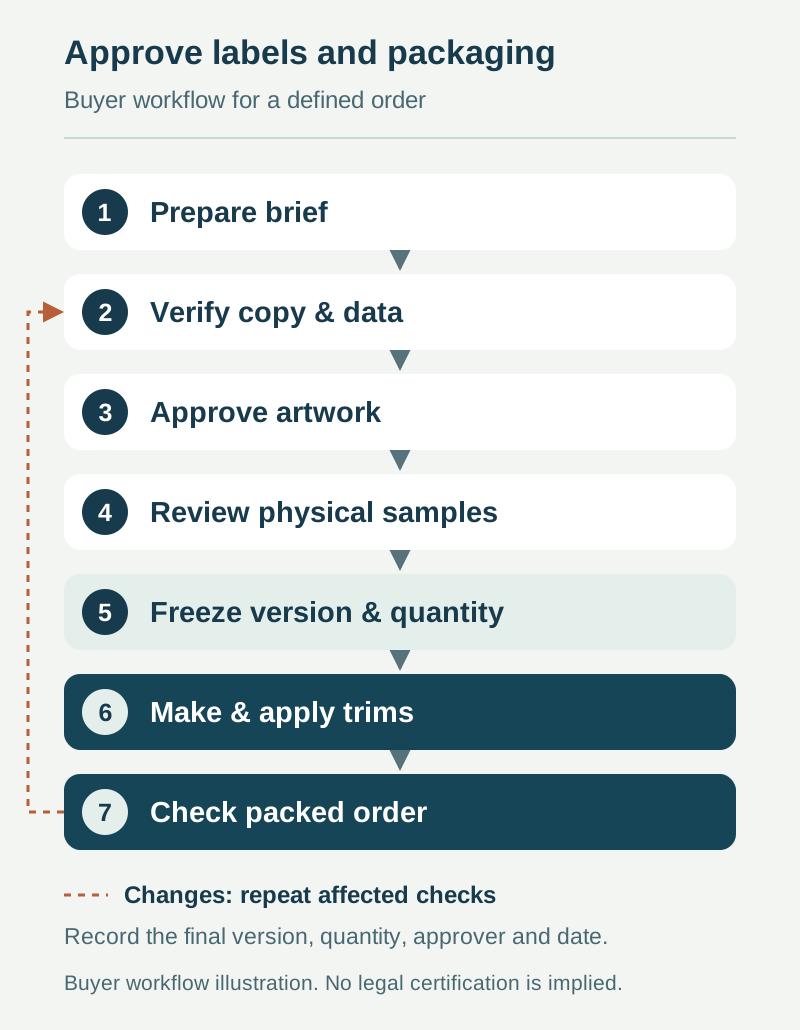
Connect this record to the garment sample approval. If the shirt is approved but final care copy is pending, state that limited scope and hold the affected work.
For a later change, identify the affected files and units, withdraw the old instruction, agree replacement evidence and record what happens to existing stock. Retain an approved reference for future reorders. Final packing checks still need to confirm the correct components were used.
Which Costs and Reorder Details Should Be Agreed in Writing?
Request separate confirmation of materials, artwork or tooling, samples, sewing or application, and packing operations. Ask whether each is included in the quote. Packaging materials and packing labor are different costs. A statement that final packing carries no additional operation charge does not make printed bags, boxes or labels free.
Confirm component minimums separately from garment quantity. Agree any surplus, ownership, storage, deterioration risk and permission to use remaining components on later orders. A changed size range, product claim or business identity may make old stock unsuitable.
Our starting fishing-shirt MOQ is 100 pieces per style and colorway, with sizes normally mixed within an approved style. Materials, decoration and packaging can change the final minimum. That does not establish a separate label or bag MOQ. Use the bulk quote guide to define the complete commercial scope.
Download the Label and Packaging Approval Sheet
Use these two blank working files together:
- Label and packaging approval sheet CSV: record the component, source, specification, version, sample reference, quantity, status, approver and change notes.
- SKU and packing master CSV: connect style, color, size, buyer-assigned identifiers and carton allocation.
Keep one current master and retain superseded versions separately. The templates contain no verified product data, scan results, inspection findings or compliance approval.
Buyer FAQs
What labels should I prepare for private-label fishing shirts sold in the US?
Plan brand and size identification, required textile information and supported care instructions for the actual adult product. Confirm wording and placement, then connect the garment to its approved hangtag, SKU and packing records.
Is a woven brand label enough for a private-label shirt?
A logo identifies the brand but does not automatically provide the product information required for the market. Review every required field and its placement separately before approving the finished label arrangement.
Do I need an RN number for my clothing label?
An RN is optional under FTC guidance. An eligible business name can identify the responsible business instead. A brand name alone does not automatically qualify, and the FTC issues RNs only to US-based businesses.
Can a hangtag replace a permanent care label?
For the ordinary adult retail shirts covered here, a removable hangtag does not replace the required permanent care label. Where packaging hides the label, additional visible care information may also be needed.
Should I approve labels and packaging with the garment sample?
Review them together when possible. If final labels or packaging are missing, identify them as open items and approve only the scope actually checked. Hold the affected bulk work until the missing decisions are resolved.
What happens if I change label artwork after approval?
Identify affected files, materials and units, stop use of the superseded version and agree the new evidence needed for approval. Record any replacement cost, schedule change and handling of already-produced components before proceeding.
Can one packaging design cover every color and size?
Shared packaging may work, but variable identifiers must remain accurate for every SKU. Check garment fit inside the package, size and color identification, barcode data and carton allocation across the approved range.
Plan Your Fishing Shirt Labels and Packaging
Send EZ Fishing Wear the sales market and channel, shirt style, quantity, colors and sizes, brand files and packing requirements. We can review the missing decisions and the samples needed for a practical approval.
Explore our labels and packaging options, or send your private-label brief. Include any retailer manual or existing component artwork so the discussion starts with the requirements your order must meet.
Written by Victor, Founder of EZ Fishing Wear. Official guidance linked above was reviewed on November 2, 2026. The templates and illustrations explain a procurement process; they do not establish that a particular garment, label or package meets its destination requirements.